

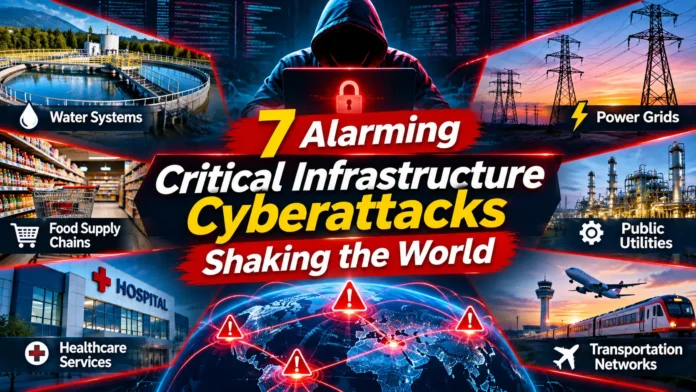
Recent disruptions have demonstrated that critical infrastructure cyberattacks are no longer confined to theoretical military scenarios. Malicious actors are aggressively infiltrating municipal water supplies, regional grocery distributors, and essential public utilities across the United States and worldwide. These brazen intrusions highlight a dangerous shift from mere digital espionage toward direct interference with foundational civilian services.
- Why Critical Infrastructure Cyberattacks Threaten Daily Life
- The Expanding Targets of Critical Infrastructure Cyberattacks
- Water Systems Under Siege: A Vulnerable Frontier
- Food Supply Chains and Supermarkets in the Crosshairs
- Geopolitical Drivers Behind Critical Infrastructure Cyberattacks
- Compound Crises: Digital Failures and Environmental Emergencies
- Defending Against Future Critical Infrastructure Cyberattacks
Why Critical Infrastructure Cyberattacks Threaten Daily Life
For decades, enterprise cybersecurity focused largely on safeguarding intellectual property, confidential emails, and financial records. However, modern threat groups now direct their campaigns toward operational technology that regulates the physical functions of civil society. When malicious actors breach industrial networks, the consequences immediately spill into communities.
The escalation of critical infrastructure cyberattacks represents an asymmetric threat capable of paralyzing essential public routines. A single compromised valve controller or automated distribution center can disrupt food deliveries to millions of households. Consequently, international security agencies warn that cyber warfare has officially entered our neighborhoods and homes.
The Expanding Targets of Critical Infrastructure Cyberattacks
Historically, sophisticated threat actors targeted oil pipelines, electric grids, and defense telecommunications networks. Today, threat actors exploit lesser-defended facilities that possess far smaller IT security budgets. Municipal utilities, local cold-storage warehouses, and regional water boards have become primary targets.
These smaller entities operate complex industrial machinery managed through internet-accessible interfaces. Attackers quickly scan the internet for unpatched firmware and default administrative credentials. As a result, critical infrastructure cyberattacks are succeeding against facilities that lack round-the-clock defensive monitoring.
Water Systems Under Siege: A Vulnerable Frontier
Among the most alarming developments is the persistent targeting of regional water authorities and treatment plants. In several confirmed incidents, hostile hackers remotely altered chemical treatment levels or disabled automated pumping mechanics. Fortunately, manual overrides and secondary physical safety protocols prevented contaminated water from reaching consumer taps.
Nevertheless, national intelligence officials emphasize that luck cannot remain our primary defense strategy. Many rural and suburban water districts rely on outdated programmable logic controllers that cannot run modern encryption. Because clean water is an irreplaceable resource, these vulnerabilities expose millions of citizens to acute health risks.
Federal cybersecurity advisories now urge municipal water managers to immediately reset factory default passwords and isolate control equipment from the open internet. The danger lies in administrative neglect, where operators leave remote desktop protocols unsecured for vendor convenience. Addressing these rudimentary gaps is crucial to stopping further unauthorized system intrusions.
Food Supply Chains and Supermarkets in the Crosshairs
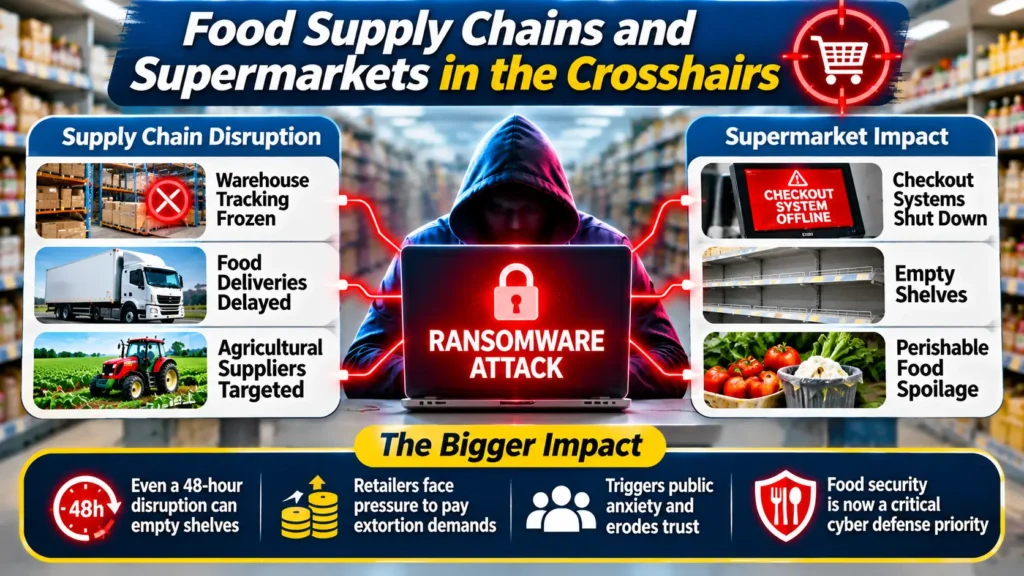
Grocery distribution chains and retail supermarket operators have simultaneously emerged as vulnerable civilian targets. Coordinated ransomware assaults have shuttered regional checkout systems and blinded warehouse tracking systems. When automated inventory networks freeze, perishable food items spoil rapidly on loading docks.
The modern grocery logistics network operates on precise, just-in-time delivery models that tolerate zero downtime. Even a forty-eight-hour disruption creates empty shelves across dozens of metropolitan supermarkets. Retailers face immense pressure to pay extortion demands simply to prevent devastating financial and community fallout.
Furthermore, attackers understand that targeting agricultural suppliers and food wholesalers magnifies public anxiety. When citizens cannot buy groceries, trust in institutional stability erodes at an alarming rate. Food security has therefore become an urgent cyber frontier requiring national-level strategic defense.
Geopolitical Drivers Behind Critical Infrastructure Cyberattacks
State-sponsored advanced persistent threat groups actively orchestrate many of these disruptive campaigns. Foreign intelligence apparatuses use proxy hacker syndicates to probe critical assets during geopolitical standoffs. This plausible deniability enables adversaries to test civilian disruption tactics without crossing the threshold of direct armed conflict.
By executing coordinated critical infrastructure cyberattacks, hostile powers signal their ability to trigger chaos at will. The goal often involves psychological coercion, distracting democratic governments from overseas conflicts through domestic turmoil. Intelligence analysts warn that these preliminary attacks effectively serve as reconnaissance for future crises.
Compound Crises: Digital Failures and Environmental Emergencies
The true danger of cyber warfare lies in its potential to strike alongside natural disasters and severe climate disruptions. When digital systems collapse during extreme weather events, emergency responders lose their ability to protect vulnerable populations. Dual crises quickly overwhelm hospital systems, backup generators, and transport networks.
Consider the devastating consequences if water and energy networks collapse during catastrophic heatwaves. We have already observed how intense climate extremes overwhelm societal resilience in events like Over 50,000 Dead: The True Toll of Europe’s Historic Heatwave, where municipal utilities faced unprecedented public health pressures. If hackers intentionally cripple cooling grids or water distribution during such heat spikes, the casualty numbers could multiply exponentially.
Disaster preparedness planners must therefore account for synchronized physical and digital emergencies. An automated cooling station or water filtration plant must remain capable of operating during external communication blackouts. Fostering resilient manual workarounds is essential to preserving human lives during compounding disasters.
Defending Against Future Critical Infrastructure Cyberattacks
Defeating these relentless digital incursions requires a complete overhaul of global utility and corporate security postures. Legacy operational technology must be strictly air-gapped from corporate business networks and public internet gateways. Mandating multi-factor authentication across all engineering access points is another vital foundational baseline.
Government regulators are also implementing mandatory incident reporting rules for all critical sector participants. Private operators can no longer conceal intrusions to protect their corporate reputations. Real-time threat intelligence sharing ensures that a vulnerability discovered in one facility is patched across thousands of others.
Ultimately, robust resilience demands continuous public-private collaboration and sustained infrastructure investment. Civil infrastructure was constructed for an era of physical locks and chain-link fences rather than sophisticated cyber warfare. Modernizing these vital assets is no longer optional; it is a fundamental imperative for global peace and survival.
Civilian resilience will ultimately be defined by how rapidly communities identify and isolate suspicious digital activity. As cyber threats expand, societies must prioritize defensive engineering over mere convenience. Protecting essential lifelines remains the most urgent challenge of our interconnected digital era.
