

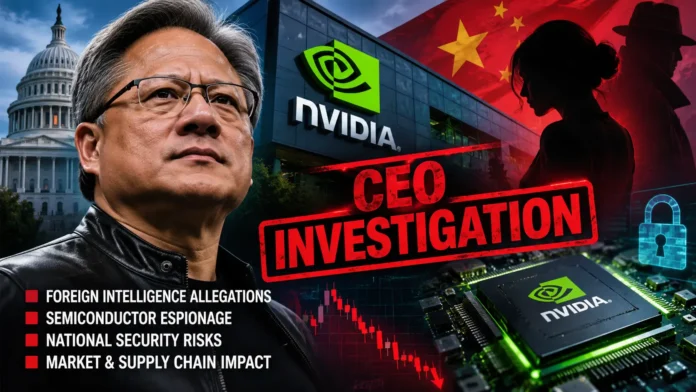
Global financial and technology markets were shaken today following breaking reports that semiconductor powerhouse Nvidia has launched an internal inquiry regarding its CEO Jensen Huang. The formal Nvidia CEO investigation centers on an alleged romantic relationship between top executive leadership and an individual identified by intelligence agencies as a suspected foreign intelligence operative. This developing corporate scandal raises urgent questions about proprietary artificial intelligence architecture and international commercial espionage.
- Origins of the Nvidia CEO Investigation
- National Security Implications and Semiconductor Espionage
- Broader Geopolitical Threats and Infrastructure Vulnerabilities
- Silicon Valley Governance in the Wake of the Probe
- Financial Markets and Global Supply Chain Disruption
- Future Outlook: What Lies Ahead for Chip Security
Origins of the Nvidia CEO Investigation
According to reports initially published by international broadcasters, independent board members initiated the inquiry after receiving classified briefings from allied counterintelligence liaisons. The probe seeks to establish whether unauthorized access was granted to internal enterprise databases, hardware design blue-prints, or future product roadmaps. Federal authorities have remained tight-lipped, but sources confirm corporate compliance auditors are actively preserving communications records.
The core focus remains on whether confidential meetings exposed next-generation graphic processor designs to unauthorized foreign entities. Company officials maintain that automated defensive layers prevent single-point data exfiltration, yet the human factor remains a perennial corporate vulnerability. Consequently, the comprehensive Nvidia CEO investigation is evaluating internal calendar logs, personal travel itineraries, and encrypted digital correspondence across several continents.
Corporate legal advisors have retained external forensic investigators to comb through petabytes of executive correspondence. Investors were caught off guard by the abrupt announcement, given the company’s unprecedented surge in valuation over the preceding fiscal quarters. While the targeted executive has not been formally charged with criminal conduct, the reputational exposure presents unprecedented challenges for the tech titan’s executive suite.
National Security Implications and Semiconductor Espionage
Semiconductors now serve as the foundational bedrock for global economic dominance, state surveillance capabilities, and autonomous military platforms. When a major hardware developer faces counterintelligence scrutiny, defense departments worldwide take immediate notice. Modern microchips represent hundreds of billions of dollars in cumulative research, making chip designs prime targets for state-sponsored intellectual property theft.
Export control measures enacted by Western regulators have severely curtailed the legal transfer of cutting-edge computing accelerators to strategic rivals. When economic sanctions choke technological pipelines, intelligence services often pivot toward aggressive human intelligence operations to bridge technical deficits. Observers warn that the vulnerabilities highlighted by this inquiry demonstrate how personal relationships can bypass perimeter digital security systems.
Investigators are working alongside Western intelligence units to evaluate whether algorithmic weights, chip interconnect specifications, or confidential software libraries were compromised. Because these microchips drive modern supercomputing clusters, even minor data leaks can compromise national security advantages. The stakes involved elevate this corporate inquiry from a standard governance issue into a matter of global geopolitical significance.
Broader Geopolitical Threats and Infrastructure Vulnerabilities
The international security ecosystem is facing simultaneous asymmetric threats across both digital and physical domains. Hostile foreign actors have demonstrated an increasing willingness to target both proprietary corporate networks and critical international data conduits. Just as state actors pursue advanced microelectronics secrets, parallel operations continue to target physical communication networks worldwide.
These coordinated strategies mirror other global crisis points where physical and cyber utilities face hostile disruption. For instance, defense analysts have pointed out similar escalations in maritime corridors, noting that Iran Prepared to Strike Gulf Undersea Internet Cables, Officials Warn in parallel strategic theaters. Such simultaneous vulnerabilities underline how modern digital infrastructure remains uniquely exposed to coordinated geopolitical sabotage.
Intelligence strategists emphasize that high-level human espionage often works in tandem with hybrid warfare against international transit lines. If elite chip architectures and undersea data vectors are compromised at the same time, global information networks face systemic fragility. Consequently, international agencies are monitoring the findings of the Nvidia CEO investigation to map out intersecting foreign intelligence vectors.

Silicon Valley Governance in the Wake of the Probe
Technology enterprises across California and global hardware hubs are hurriedly reassessing their internal counter-espionage safeguards. Historically, commercial technology firms operated with open academic collaboration models that prioritized engineering innovation over defensive secrecy. Today’s geopolitical tensions have permanently altered that posture, requiring corporate boards to adopt strict defense-grade vetting protocols.
Corporate governance specialists argue that high-ranking tech leaders require closer background auditing than traditional executives due to their direct exposure to critical national infrastructure. The corporate review currently underway underscores how modern leadership ethics intersect directly with foreign counter-surveillance obligations. Shareholder activist groups are already preparing resolutions demanding enhanced oversight of executive foreign contacts and external relationships.
Boardrooms across the semiconductor industry are holding emergency compliance audits to ensure similar risks are mitigated within their own ranks. Many technology companies have historically treated human intelligence defenses as an afterthought compared to cloud network firewalls. This high-profile inquiry provides an unmistakable signal that personal vulnerabilities can neutralize billions spent on enterprise software security.
Financial Markets and Global Supply Chain Disruption
Wall Street reaction has been swift, with chip manufacturers experiencing immediate downward volatility following the public disclosures. Investors fear that regulatory scrutiny could trigger punitive compliance mandates or slow down international export licensing approvals. With billions of capital tied directly to future product delivery cycles, any operational delay creates massive ripples across consumer tech and enterprise AI industries.
Supply chain partners in Taiwan, South Korea, and Europe are monitoring the administrative probe with profound concern. Modern computing hardware relies on an intricate web of specialized foundries, chemical suppliers, and equipment vendors that require absolute predictability. Protracted disruptions within executive leadership can postpone capital allocation decisions and stall joint development initiatives indefinitely.
Institutional investors are demanding transparency regarding the scope of the external forensic audit. Fund managers have emphasized that clear separation between executive leadership and day-to-day hardware manufacturing must be verified quickly to maintain market stability. In the interim, market volatility highlights the fragile intersection between executive conduct, strategic technology, and global investor confidence.
Future Outlook: What Lies Ahead for Chip Security
As independent investigators continue their exhaustive review, the semiconductor sector stands on the precipice of a new regulatory paradigm. Corporate espionage will no longer be treated as an isolated risk relegated to industrial espionage novels. Instead, comprehensive counterintelligence safeguards will become mandatory operational standard operating procedures for tech executives globally.
The definitive outcome of the current corporate inquiry will likely shape technology export policies, human resource vetting, and strategic alliance rules for years to come. Regulatory agencies in Washington, London, and Brussels are expected to use the findings to tighten corporate oversight mandates significantly. Ultimately, the industry must adapt to an era where technological innovation is inseparable from state-level intelligence competition.
