

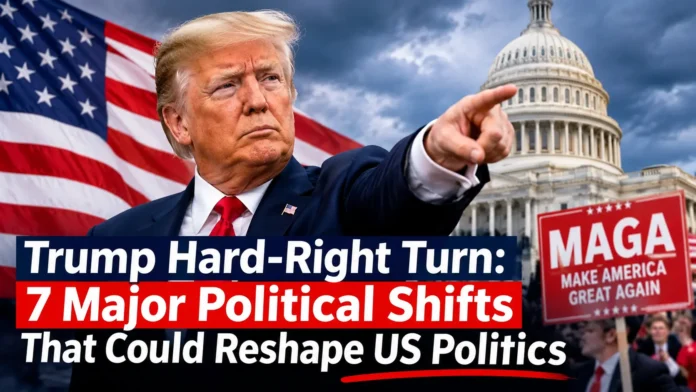
Donald Trump is signalling a tougher political approach following the 2026 midterm elections, raising fresh questions about the future direction of American conservative politics. After describing the election results as a “giant step back in History,” the US president has indicated that his administration intends to push forward rather than retreat from its political agenda.
The emerging Trump hard-right turn comes at a challenging moment for the Republican Party. Democrats made significant gains in the midterm elections, with projections indicating that they will take control of both chambers of Congress. The results have intensified discussions about the Republican Party’s electoral strategy, the future of the MAGA movement and the administration’s approach to immigration, federal governance and international relations.
Rather than interpreting the results as a reason to move towards the political centre, Trump’s latest personnel and policy signals suggest a renewed emphasis on his established political priorities. One particularly significant development is the appointment of immigration hardliner Stephen Miller as the next White House chief of staff.
Here are seven major developments shaping the debate over Trump’s political direction and their potential implications for the United States.
Table of Contents
- Trump’s Reaction to the 2026 Midterm Elections
- Trump Hard-Right Turn and the MAGA Movement
- Immigration Enforcement Could Become a Central Priority
- Federal Government Restructuring and Institutional Conflicts
- Growing Divisions Within the Republican Party
- Economic Concerns and Everyday American Priorities
- Global Consequences of Trump’s America First Agenda
- What Lies Ahead for American Politics?
Trump’s Reaction to the 2026 Midterm Elections
The 2026 midterm elections have created a significant political challenge for Donald Trump and the Republican Party. Democratic candidates secured victories across several important contests, while projections indicated that Democrats would gain control of both the House of Representatives and the Senate.
Trump responded by questioning the direction taken by the electorate. In a social media post on November 8, he described the election outcome as a “giant step back in History” and expressed confidence that his political movement would return stronger.
His response highlights an important aspect of the administration’s political strategy. Rather than immediately presenting the election results as a reason to reconsider its broader ideological direction, Trump has continued to defend his political approach.
However, the election results have also raised questions about the issues that influenced voters. Economic pressures, foreign policy disagreements, immigration enforcement and dissatisfaction with the administration’s decisions have all become subjects of debate.
The challenge for Republicans is to understand whether their electoral difficulties reflect dissatisfaction with individual candidates, specific policies or the broader direction of the party.
Trump Hard-Right Turn and the MAGA Movement
The Trump hard-right turn reflects a continuing emphasis on the ideological principles associated with the Make America Great Again (MAGA) movement.
For years, Trump’s political identity has centred on national sovereignty, restrictive immigration policies, economic protectionism and opposition to what supporters describe as excessive federal bureaucracy.
Recent developments suggest that these priorities will remain central to his political approach.
One notable personnel decision is the appointment of Stephen Miller as the incoming White House chief of staff. Miller has played a prominent role in developing and advocating the administration’s restrictive immigration policies.
His elevation is widely being interpreted as a signal that immigration enforcement and other established administration priorities will remain prominent.
Nevertheless, personnel changes alone do not establish the details of future legislation or executive action. The administration’s actual direction will become clearer through formal policy announcements and implementation.
For MAGA supporters, maintaining a firm ideological position may demonstrate consistency. Critics, however, argue that the Republican Party also needs to understand why its message did not attract enough voters in key electoral contests.
Immigration Enforcement Could Become a Central Priority
Immigration remains one of the defining issues of Trump’s political agenda.
The administration has consistently advocated stricter border controls, stronger enforcement measures and changes to existing immigration procedures.
With Stephen Miller moving into the chief of staff position, immigration policy is likely to remain a major focus of White House discussions.
Potential areas of continued emphasis include:
- Expanded immigration enforcement operations.
- Greater scrutiny of asylum applications.
- Stronger border security measures.
- Increased interior immigration enforcement.
- Changes to immigration procedures and federal enforcement priorities.
Supporters argue that stricter enforcement is necessary to strengthen national border security and improve immigration management.
Opponents raise concerns about due process, humanitarian protections, family separation and the economic consequences of large-scale deportation programmes.
The Trump hard-right turn therefore carries significant implications for immigrants, employers, border communities and the wider American economy.
The extent of any further policy changes will depend on the administration’s formal decisions, available resources and legal challenges.
Federal Government Restructuring and Institutional Conflicts
Another important feature of Trump’s political approach involves his criticism of established federal institutions.
His administration has advocated substantial changes to the federal bureaucracy, arguing that government agencies need greater accountability and should operate in accordance with the president’s policy priorities.
However, these objectives frequently generate disagreements over executive authority, administrative independence and constitutional checks and balances.
The political consequences could become more significant as Democrats prepare to assume control of both congressional chambers.
With control of congressional committees, Democratic lawmakers will have greater opportunities to investigate administration decisions, request documents, conduct hearings and scrutinise federal agencies.
This creates the possibility of an increasingly confrontational relationship between the White House and Congress.
The coming legislative period could therefore involve disputes over executive power, federal spending, immigration enforcement and government oversight.
Growing Divisions Within the Republican Party
The Trump hard-right turn also brings renewed attention to disagreements within the Republican Party.
Although Trump continues to exercise considerable influence over the party’s political identity, the 2026 midterm results have created pressure for a broader discussion about its electoral strategy.
Some Republican figures have emphasised the importance of understanding voter dissatisfaction, particularly concerning economic conditions and the administration’s foreign policy decisions.
Vice President JD Vance has publicly highlighted the Iran war and its economic consequences as important factors in understanding the Republican losses.
Other Republican voices have also called for the party to examine its messaging and reconnect with voters concerned about everyday economic pressures.
These disagreements reveal different approaches to the party’s future.
One position emphasises maintaining the existing MAGA agenda and strengthening its appeal among committed conservative voters. Another argues that Republicans must broaden their message to connect with independents, suburban communities and voters concerned primarily with economic issues.
The debate is not simply about campaign messaging. It concerns the long-term identity of the Republican Party and how it should balance ideological consistency with a broader electoral coalition.
Economic Concerns and Everyday American Priorities
While ideological debates dominate Washington, everyday economic concerns remain important to American households.
Inflation, grocery prices, housing expenses, healthcare costs and employment conditions directly influence how families evaluate the performance of political leaders.
This creates an important challenge for the Trump administration.
Political messaging centred on immigration, cultural issues and federal restructuring may energise particular sections of the electorate. However, voters also expect practical improvements in their financial circumstances.
The relationship between economic performance and political approval is especially relevant following the 2026 midterm elections.
Republican officials and political commentators have raised concerns about the cost of living and the impact of foreign policy decisions on energy prices.
These issues demonstrate why political strategy cannot be evaluated exclusively through ideological positioning.
For many households, the effectiveness of government is measured through purchasing power, employment opportunities, consumer protection and the affordability of essential goods.
The administration will therefore face pressure to demonstrate how its policies address these everyday concerns alongside its broader political objectives.
Global Consequences of Trump’s America First Agenda
The Trump hard-right turn could also influence America’s international relationships.
His America First approach places considerable emphasis on national economic interests, trade negotiations, border security and the distribution of responsibilities among international allies.
A stronger emphasis on these priorities could affect discussions involving tariffs, international trade agreements, climate commitments and collective defence arrangements.
European governments and Indo-Pacific partners will continue to assess how American foreign policy decisions influence their economic and security interests.
For NATO members, questions surrounding defence spending and shared security responsibilities remain particularly important.
International businesses and financial markets may also pay close attention to potential changes in American trade policy.
Supporters of Trump’s approach argue that a stronger emphasis on national interests can improve America’s negotiating position.
Critics, however, warn that prolonged trade disputes and uncertainty surrounding international commitments could create difficulties for economic cooperation and diplomatic relationships.
The consequences will depend on the administration’s specific decisions rather than political rhetoric alone.
What Lies Ahead for American Politics?
The Trump hard-right turn presents the Republican Party with a series of difficult questions following its 2026 midterm setbacks.
Will the administration maintain its established ideological priorities, or will the election results encourage a reassessment of its political strategy?
The appointment of Stephen Miller suggests that immigration enforcement will remain prominent. At the same time, Democratic control of Congress will create additional scrutiny of presidential decisions and could make legislative negotiations more complicated.
Republicans must also address disagreements over economic policy, foreign affairs and the issues that matter most to voters.
For Trump, the immediate challenge involves maintaining the support of his political base while governing in an environment where congressional opposition will have greater institutional power.
The coming months will provide a clearer picture of whether the administration responds to the election results through policy adjustments, intensified ideological positioning or a combination of both.
Ultimately, the debate surrounding Trump’s political direction extends beyond one election cycle. It raises broader questions about the future of American conservatism, the balance of power between government institutions and the role of the United States in international affairs.
The direction taken by the administration will be closely watched by political observers, policymakers, international partners and American voters.
Editorial note: Political developments and election projections in this article reflect reporting available as of November 9, 2026. Future policy changes and their consequences remain subject to official decisions and legislative developments.
