

Introduction: India’s Passenger Aircraft Dream
India today represents one of the world’s fastest-growing aviation markets. The country’s airlines have placed orders for more than a thousand aircraft, regional airports are expanding under the UDAN scheme, and passenger traffic continues to grow at a remarkable pace. Yet despite being one of the largest consumers of commercial aircraft, India has historically remained dependent on foreign manufacturers for almost every passenger aircraft flying in its skies.
For decades, commercial aviation in India has been dominated by aircraft built by Airbus, Boeing, ATR, and Embraer. While Indian engineers have demonstrated significant capabilities in defense aerospace, space technology, and software systems, the country has never successfully produced a large-scale commercial passenger aircraft.
That situation may be beginning to change.
Over the past few years, India has launched several initiatives aimed at building an indigenous aerospace manufacturing ecosystem. These include the Airbus-Tata C-295 production line, the proposed HAL-UAC SJ-100 regional jet project, the National Aerospace Laboratories’ Saras aircraft, and the ambitious Indian Regional Jet (IRJ) programme.
Government announcements and media headlines frequently describe these developments as evidence that India is now “making passenger aircraft.” However, a closer examination reveals a more nuanced reality.
India is undoubtedly making progress, but much of that progress currently lies in aircraft assembly, licensed production, and supply-chain development rather than full-scale indigenous aircraft manufacturing.
Understanding this distinction is essential for evaluating India’s true position in the global aerospace industry.
The Difference Between “Made in India” and “Assembled in India”
In everyday conversation, people often use the terms interchangeably. In aerospace, however, they represent very different levels of technological capability.
Aircraft assembly involves integrating parts and systems manufactured elsewhere into a completed aircraft. This includes joining airframe sections, installing avionics, engines, landing gear, interiors, and conducting testing before delivery.
Under licensed manufacturing, a country produces parts or entire aircraft using foreign designs and intellectual property while following specifications established by the original manufacturer.
True indigenous manufacturing means the aircraft is designed, engineered, tested, certified, and produced domestically. The country owns the intellectual property and controls future development.
The highest level involves not only designing aircraft but also developing engines, avionics, flight-control systems, materials, certification expertise, and a complete supplier ecosystem.
By these standards, India is currently transitioning from assembly and licensed manufacturing toward indigenous development but has not yet achieved complete aerospace self-reliance.
Airbus C-295: India’s Most Visible Aerospace Manufacturing Project
The Airbus C-295 programme is often cited as proof that India has entered the aircraft-manufacturing era.
The reality is both impressive and more complicated.
Through a partnership between Airbus and Tata Advanced Systems, a Final Assembly Line (FAL) has been established in Vadodara, Gujarat. This facility will assemble dozens of aircraft for the Indian Air Force while creating a domestic aerospace supply chain.
From an industrial perspective, this is a landmark achievement.
Thousands of components are being produced within India. Local suppliers are gaining experience with aerospace-grade manufacturing standards. Engineers and technicians are learning complex aircraft integration processes.
However, the C-295 remains fundamentally a Spanish aircraft.
The aircraft was designed by Airbus. Certification authority remains with Airbus. The core intellectual property belongs to Airbus. Many critical systems continue to originate from international suppliers.
Consequently, describing the aircraft as entirely “Made in India” would be inaccurate.
A more precise description would be:
“Airbus-designed aircraft increasingly manufactured and assembled in India.”
This distinction is important because ownership of design and intellectual property ultimately determines long-term technological independence.
The Proposed HAL SJ-100 Programme
India’s reported collaboration with Russia’s United Aircraft Corporation (UAC) regarding the SJ-100 regional jet has generated significant interest.
The aircraft is designed to carry approximately 100 passengers and could help strengthen regional connectivity across India.
Supporters argue that domestic production of the SJ-100 would create aerospace jobs, transfer manufacturing knowledge, reduce dependence on imported aircraft, and develop India’s regional aviation sector.
However, critics point to several concerns.
The SJ-100 is fundamentally a Russian aircraft. Its commercial success has been limited compared to Western competitors. International sanctions have affected supply chains and certification pathways.
Even if assembled in India, the programme would not necessarily provide India with ownership of critical technologies or design authority.
The project may therefore be valuable as a learning opportunity but should not be confused with indigenous aircraft development.
Saras: India’s First Indigenous Civil Aircraft
Unlike the C-295 and SJ-100, the Saras project represents a genuinely Indian aerospace effort.
Developed by the National Aerospace Laboratories (NAL), Saras was conceived as a multi-purpose civilian aircraft capable of carrying 14 to 19 passengers.
The programme has faced numerous challenges, including technical setbacks, funding constraints, certification delays, and changing operational requirements.
Critics often cite these delays as evidence of failure.
However, such criticism frequently overlooks a fundamental reality: aircraft development is among the most difficult engineering challenges in existence.
Even Boeing, Airbus, Embraer, and Bombardier have experienced delays, redesigns, and cost overruns.
The true value of Saras extends beyond the aircraft itself.
The programme has enabled India to build expertise in aerodynamic design, flight testing, systems integration, structural analysis, aircraft certification, and civil aviation engineering.
These capabilities form the foundation for future aircraft programmes.
The Indian Regional Jet: India’s Real Test
If Saras represents India’s first step into civil aviation, the proposed Indian Regional Jet (IRJ) represents the real challenge.
The aircraft is expected to seat between 70 and 100 passengers and compete in the regional aviation market.
This would place India in direct competition with established manufacturers such as Airbus, ATR, Embraer, and COMAC.
The potential benefits are enormous.
India’s domestic aviation market is expanding rapidly. Hundreds of smaller cities require reliable regional connectivity. An Indian-designed regional jet could reduce import dependence while generating high-value manufacturing jobs.
Yet the challenges are equally significant.
Designing an aircraft is only part of the problem.
Manufacturers must also obtain certification, establish maintenance networks, build supplier ecosystems, secure airline confidence, guarantee spare parts support, and ensure long-term reliability.
Many promising aircraft programmes around the world have failed because they could not overcome these commercial challenges.
For India, the IRJ will be the ultimate test of whether the country can evolve from aircraft assembler to aircraft designer.
The Biggest Challenge: Aircraft Engines
Perhaps the most important obstacle facing Indian aerospace ambitions is engine technology.
Modern turbofan engines are among the most sophisticated machines ever built.
Only a handful of companies possess the expertise to develop them: GE Aerospace (United States), Pratt & Whitney (United States), Rolls-Royce (United Kingdom), Safran (France), and CFM International (France-USA).
India’s long-running Kaveri engine programme demonstrated the extraordinary complexity involved in engine development.
Without a domestic commercial engine programme, even future Indian-designed aircraft will likely depend on foreign propulsion systems.
This means that claims of complete aviation self-reliance remain premature.
Where Do Aircraft Components Come From?
One of the biggest misconceptions surrounding aircraft manufacturing is the belief that an aircraft is produced entirely within a single country.
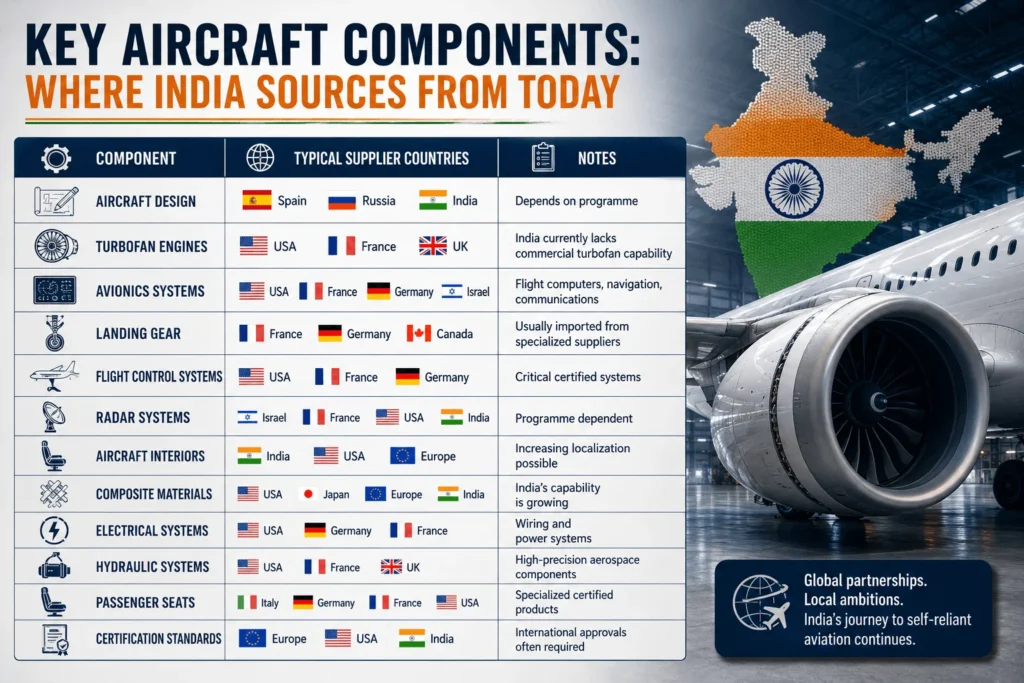
In reality, modern aircraft are global products. Even Boeing and Airbus source components from dozens of countries. The table below illustrates the likely origin of major systems involved in aircraft being assembled or developed in India.
| Component | Typical Supplier Countries | Notes |
| Aircraft Design | Spain, Russia, India | Depends on programme |
| Turbofan Engines | USA, France, UK | India currently lacks commercial turbofan capability |
| Avionics Systems | USA, France, Germany, Israel | Flight computers, navigation, communications |
| Landing Gear | France, Germany, Canada | Usually imported from specialized suppliers |
| Flight Control Systems | USA, France, Germany | Critical certified systems |
| Radar Systems | Israel, France, USA, India | Programme dependent |
| Aircraft Interiors | India, USA, Europe | Increasing localization possible |
| Composite Materials | USA, Japan, Europe, India | India’s capability is growing |
| Electrical Systems | USA, Germany, France | Wiring and power systems |
| Hydraulic Systems | USA, France, UK | High-precision aerospace components |
| Passenger Seats | Italy, Germany, France, USA | Specialized certified products |
| Certification Standards | Europe, USA, India | International approvals often required |
This table highlights a crucial reality:
Even aircraft assembled in India remain dependent on a global supply chain.
The challenge is not eliminating imports entirely but increasing domestic participation in high-value technologies.
Lessons from China’s COMAC C919
China’s experience provides an important lesson for India.
The COMAC C919 was launched with strong government backing and billions of dollars in investment. Yet it took nearly two decades to move from concept to commercial operations.
Even today, the aircraft relies on numerous foreign suppliers for critical systems.
The lesson is simple:
Building an aircraft is difficult.
Building an aircraft industry is even harder.
India’s journey will likely require sustained investment over multiple decades rather than a few years.
Conclusion: Progress Worth Celebrating, But Expectations Must Be Realistic
India’s aviation ambitions deserve recognition.
The Tata-Airbus C-295 programme has established a modern aerospace manufacturing ecosystem. The Saras programme has demonstrated indigenous design capability. The proposed Indian Regional Jet reflects a long-term vision for commercial aviation independence.
Yet India has not reached the stage where it can be considered a fully self-reliant aircraft-manufacturing nation.
Much of the country’s current progress is concentrated in assembly, licensed production, and supply-chain development rather than complete aircraft ownership and design.
This is not a failure.
In fact, it is how most aerospace powers began their journey.
The real question is whether today’s assembly lines become tomorrow’s design centres.
If India successfully develops the Saras platform, advances the Indian Regional Jet programme, strengthens domestic avionics and engine capabilities, and builds a globally competitive supplier ecosystem, it could eventually join the small group of nations capable of independently designing and manufacturing commercial aircraft.
Until then, the most accurate description of many current programmes is not “Made in India” but rather “Assembled in India with growing Indian manufacturing content.”
That may sound less dramatic, but it is a far more honest measure of where India’s aerospace industry stands today.
