

In a diplomatic development monitored worldwide, the leaders of the United States, Russia, and China have convened for an unprecedented trilateral meeting. According to reports from the BBC and Reuters, Donald Trump, Vladimir Putin, and Xi Jinping concluded their summit by issuing a joint historic peace declaration aimed at reducing great-power frictions. While the leaders praised the gathering as a milestone for international stability, media outlets including The Guardian observed notable silences regarding current global wars.
The surprise summit has sparked widespread debate across foreign policy circles and financial markets. Observers are evaluating whether the signed text represents a substantive framework for detente or a symbolic gesture among competing global rivals.
Unprecedented Diplomacy Behind the Historic Peace Declaration
The meeting marked the first time the three leaders gathered at a single table to directly negotiate mutual security interests. Reuters reported that the discussions were held behind closed doors, focusing on preventing accidental escalation among nuclear-armed states. Both Washington and Beijing characterized the dialogue as frank, necessary, and focused on shared survival.
Diplomatic correspondents from the BBC highlighted that personal chemistry and direct engagement were prioritized throughout the negotiations. Each leader approached the summit seeking domestic and international leverage amidst ongoing structural tensions. The release of the document signals a mutual desire to showcase communication channels remain open despite severe geopolitical rivalry.
Supporters of the talks argue that bringing the three dominant global military powers together is fundamentally stabilizing. They contend that direct dialogue minimizes the risk of catastrophic miscalculation across sensitive regions. Conversely, skeptical analysts caution that diplomatic summits often yield high rhetoric with limited operational change on the ground.
Key Commitments in the Historic Peace Declaration
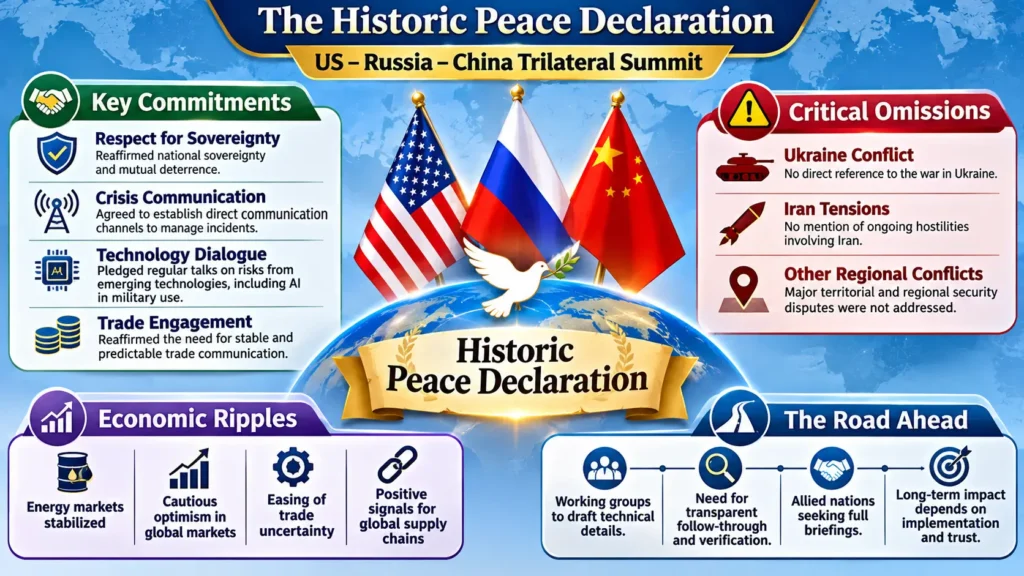
The central text of the document emphasizes principles of sovereignty, mutual deterrence, and crisis management. As detailed by Reuters, the signatories agreed to establish dedicated trilateral hotlines between their defense ministries. These communication lines are designed to provide rapid verification during maritime or aerospace incidents.
Furthermore, the leaders pledged cooperation on emerging technological risks, particularly the governance of autonomous weapons systems. The historic peace declaration outlines broad intentions to maintain regular strategic dialogues on artificial intelligence in military operations. Observers view this technical coordination as a pragmatic recognition of shared technological vulnerabilities.
Trade communication channels were also reaffirmed within the text to prevent sudden economic disruptions. While specific tariff disputes were not resolved, the leaders affirmed the necessity of predictable commercial interactions. Establishing predictable engagement protocols was celebrated by the delegations as a core achievement of the summit.
Critical Omissions from the Historic Peace Declaration
Despite the broad language of reconciliation, independent analysts were quick to notice significant gaps in the communiqué. The Guardian reported that the text conspicuously omitted direct references to the conflict in Ukraine or ongoing hostilities involving Iran. The absence of these major flashpoints has drawn sharp criticism from several international observers and allied nations.
European officials expressed concern that sidelining the war in Ukraine risks undermining collective security arrangements. Many Western diplomats argue that a genuine security compact must address active territorial disputes to remain credible. Leaving such acute conflicts unmentioned suggests the leaders chose broad consensus over contentious resolution.
Similarly, regional experts noted that omitting Middle Eastern security questions leaves core instability factors unaddressed. Analysts suggest that tackling these volatile conflicts could have derailed the negotiations entirely. Consequently, the document focused exclusively on issues where baseline common ground could be presented publicly.
This deliberate avoidance highlights the pragmatic yet fragile nature of the consensus achieved. By sidestepping intractable territorial wars, the participants secured an agreeable text at the cost of addressing current battlegrounds. Critics view this as a missed opportunity, while defenders maintain it was the only realistic way to sign a joint statement.
Economic Ripples of the Historic Peace Declaration
Global financial markets reacted with cautious optimism following the publication of the joint statement. Energy commodities stabilized as traders evaluated the reduced likelihood of sudden naval blockades or broad sanctions expansions. Investors generally welcome trilateral engagement as an indicator that major trade wars may face procedural dampeners.
The summit’s economic dimension intersects closely with broader debates over global governance and fiscal strategy. For instance, discussions surrounding Trump’s Economic Legacy Assessed as Airbnb Overhauls Host Rules illustrate how trade stances continue to influence modern domestic and international policy. Balancing national economic protectionism with open diplomatic dialogue remains an ongoing challenge for Washington policymakers.
Corporate executives across manufacturing and technology sectors are closely monitoring the implementation of the communication pledges. Supply chains remain sensitive to regulatory friction and political tension among Washington, Moscow, and Beijing. Even modest reductions in cross-border uncertainty could influence capital allocation decisions over the coming fiscal quarters.
The Road Ahead for the Historic Peace Declaration
The long-term value of the document will depend entirely on practical compliance and bilateral follow-through. Working groups are expected to assemble in the coming months to draft technical parameters for the agreed hotlines. Without verifiable enforcement mechanisms, international agreements risk becoming symbolic footnotes in diplomatic history.
Allied capitals in Europe and Asia are demanding comprehensive briefings regarding any informal agreements made during the closed sessions. Trust remains exceptionally low between the Western bloc and its strategic competitors, presenting substantial obstacles to lasting cooperation. Skeptics maintain that structural conflicts over technology, trade, and regional sovereignty will inevitably test the accords.
Ultimately, the publication of the historic peace declaration represents a notable shift toward structured communication among top geopolitical rivals. Whether it paves the way for genuine security architecture or merely provides temporary diplomatic respite remains to be seen. The international community now watches closely to see if concrete actions match the summit’s high aspirations.
