

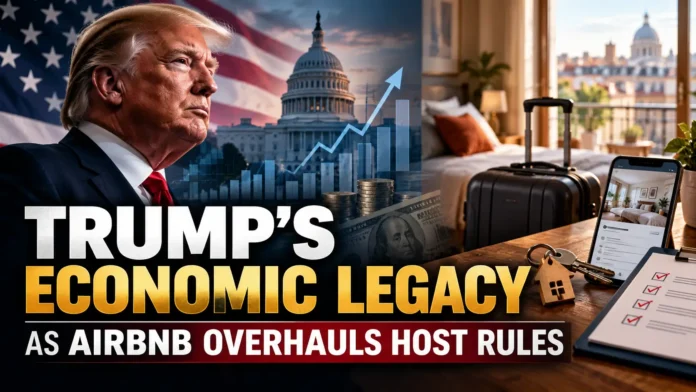

The global economic landscape frequently presents dual narratives: high-level macroeconomic strategies crafted in corridors of political power and micro-level platform policies that dictate everyday commerce. Today’s international focus highlights this exact juxtaposition. On one front, economists, policymakers, and voters continue to evaluate the empirical outcomes of Donald Trump’s signature economic promises, examining how protectionist tariffs, substantial corporate tax cuts, and aggressive deregulation have fundamentally reshaped international trade and domestic growth. On another front, Airbnb—the titan of the modern peer-to-peer sharing economy—is enacting comprehensive rule revisions for hosts worldwide, responding to intensifying regulatory crackdowns, changing traveler preferences, and widespread complaints over hidden fees.
Together, these developments provide a compelling lens into how modern governance, corporate agility, and consumer behavior interact. As fiscal doctrines face scrutiny against hard data and digital platforms adapt to survive in mature urban markets, the ripple effects are felt across global markets, real estate sectors, and household budgets alike.
Evaluating Trump’s Economic Blueprint: Intentions versus Outcomes
During his administration and throughout his subsequent political campaigns, Donald Trump championed an economic agenda built on economic nationalism, labeled broadly under the “America First” umbrella. The central tenets included resurrecting domestic manufacturing, cutting corporate taxes to incentivize capital repatriation, slashing bureaucratic red tape, and wielding unilateral tariffs to eliminate trade deficits. With years of historical data now accessible, economists have developed a clearer picture of how these theoretical pledges played out across real-world markets.
The cornerstone of the legislative effort was the Tax Cuts and Jobs Act (TCJA) of 2017, which lowered the corporate tax rate from 35 percent to 21 percent. Proponents argued this maneuver would trigger sustained annual GDP growth rates exceeding 3 to 4 percent and unleash a wave of domestic capital investments. In the immediate aftermath, business spending rose, stock markets rallied, and corporate repurchases hit historic peaks. However, independent analyses by institutions like the Congressional Budget Office (CBO) noted that while the stimulus bolstered short-term growth, long-term capital formation did not sustain the stratospheric trajectories promised. Simultaneously, the federal debt expanded significantly, creating fiscal constraints that continue to fuel debates over entitlement spending and budget deficits today.
Perhaps the most radical departure from traditional free-market orthodoxy was Trump’s tariff policy. Sweeping levies were imposed on foreign steel, aluminum, and hundreds of billions of dollars worth of Chinese imports. The overarching goal was to force multinational corporations to repatriate supply chains and revive industrial manufacturing employment in the Rust Belt. While specific domestic metals producers experienced short-lived profit boosts, counter-tariffs by trading partners slammed the American agricultural sector, necessitating massive federal subsidy bailouts. Furthermore, research from the Federal Reserve indicated that higher input costs for downstream manufacturers ultimately neutralized job gains, demonstrating the extreme difficulty of decoupling tightly integrated global supply lines overnight.
Airbnb Overhauls Host Policies Amid Global Market Pressures
While macro-level trade battles redefine international supply lines, microeconomic shifts are fundamentally altering the hospitality industry. Airbnb has announced a series of critical platform updates and operational mandates aimed at tightening host standards, standardizing pricing structures, and reclaiming user trust. This overhaul comes at a critical juncture, as municipal authorities across North America, Europe, and Asia implement stringent local ordinances to protect urban housing supplies.
Under the updated policy framework, Airbnb is focusing heavily on pricing transparency and listing integrity. Key revisions include:

- Upfront Total Price Display: Mandating that search results exhibit all cleaning fees, service charges, and local taxes before checkout, mitigating user frustration over deceptive base rates.
- Stringent Quality Standards: Removing listings that persistently underperform in cleanliness, accurate location descriptions, and host responsiveness, with automated delisting mechanisms for repeat violators.
- Checkout Task Limitations: Barring hosts from demanding excessive guest chores—such as deep-cleaning kitchens, stripping beds, or mowing lawns—while simultaneously charging high sanitation fees.
- Dispute Resolution and Cancellation Protections: Strengthening guest reimbursement guarantees in situations where properties do not match digital representations or present safety hazards.
These policy interventions stem directly from municipal headwinds. Cities like New York, Barcelona, and Berlin have imposed severe restrictions or outright bans on unhosted short-term rentals, arguing that unrestrained residential conversions deplete long-term rental stock and escalate living costs for residents. By enforcing institutional professionalism upon everyday hosts, Airbnb seeks to reposition itself from an unregulated peer-to-peer disruptor to a compliant, institutionalized hospitality ecosystem.
Macro Trends Converging with Micro Realities
The intersection of economic policy and digital platforms highlights how macroeconomic shifts alter ground-level operations. For instance, the inflationary cycles and rising interest rates that followed historic federal spending and disrupted global supply chains have dramatically increased mortgage costs. Consequently, prospective real estate investors who previously relied on the short-term rental arbitrage model—leasing properties to rent them out on Airbnb—now face compressed margins and regulatory barriers. What was once seen as an effortless avenue for passive income is now a highly scrutinized enterprise demanding strict professional compliance.
This dynamic demonstrates that public narratives frequently fluctuate between grand political visions and pragmatic, structural realities. In both politics and media, lasting success depends less on initial branding and more on sustained execution under pressure. This phenomenon is visible across varied fields. Just as economic policy and commercial platforms must evolve beyond rhetoric to maintain public confidence, cultural media often discovers that enduring legacies rely on discipline and authentic presence. Exploring deep-rooted cultural transformations reveals parallels across industries, as documented in Pradeep Rawat: The Definitive Legacy of the Silent Giant of Indian Cinema, which underscores how true impact across long careers is carved out through substance, deliberate reinvention, and fundamental reliability rather than fleeting spectacle.
The Road Ahead: Reconciling Trade Ambitions and Digital Commerce
Looking to the future, both national economic governance and digital real estate platforms face profound structural challenges. In the political realm, protectionist trade rhetoric shows no signs of waning. Both major political parties in the United States have maintained or expanded restrictions on international competitors, signaling a bipartisan departure from late-20th-century globalization. The ongoing test for future administrations will be maintaining domestic price stability and technological competitiveness while navigating higher baseline interest rates and an expanding national debt.
For platforms like Airbnb, the focus must remain on balanced coexistence with municipal governance. As metropolitan hubs prioritize resident affordability, the sharing economy cannot afford to operate without regulatory alignment. Platforms that prioritize customer transparency, sustainable neighborhood practices, and predictable standards will likely secure longevity, whereas those relying on regulatory loopholes will face compounding legal resistance.
Ultimately, whether analyzing multi-trillion-dollar federal policies or algorithmic shifts on an accommodation app, the underlying lesson remains constant: policy promises must invariably survive the test of real-world friction. As consumers, travelers, and businesses navigate this evolving terrain, success hinges on accountability, sustainable planning, and the adaptability to pivot when conditions demand change.
