
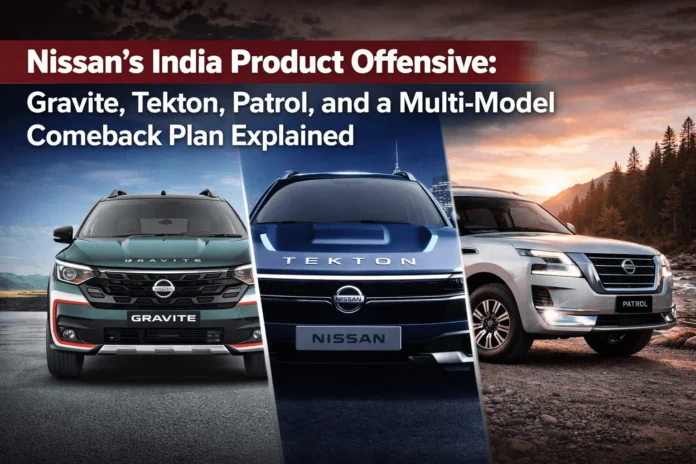
Nissan is staging one of its most ambitious comebacks in the Indian auto market.
After years of operating with a single model — the Magnite — the Japanese automaker has unveiled an aggressive multi-model roadmap spanning 2026–2027, backed by investments worth several hundred million dollars. From the budget-friendly Gravite MPV to the premium Tekton SUV and the legendary Patrol flagship, here’s everything you need to know about Nissan’s India strategy.
Why Nissan’s India Push Matters Right Now
India is the world’s third-largest passenger vehicle market, selling over 4.7 million units annually — and it’s still growing. Yet for years, Nissan held a meagre 0.5% market share, largely because it had only one product to sell: the Magnite compact SUV.
That changes now.
“India is central to Nissan’s global ambitions,” said Thierry Sabbagh, Divisional Vice President and President for Nissan’s Middle East, KSA, CIS, and India operations. “Our actions over the past year — strengthening operations, expanding the network and embarking on a product offensive — demonstrate our long-term commitment to this market.”
The company isn’t just chasing domestic volume. In 2025, Nissan exported 1.2 million Made-in-India vehicles to 65 countries DriveSpark, firmly establishing India as a critical manufacturing and export hub — not just a sales destination.
Nissan’s India Product Roadmap: 4 Models, 2 Years
Here is its confirmed launch timeline at a glance:
| Model | Segment | Expected Launch | Starting Price (est.) |
| Gravite | 7-Seater MPV | Launched (Jan–Mar 2026) | ₹5.65 lakh |
| Tekton | Mid-Size SUV (C-SUV) | Mid-2026 | ₹11–19 lakh |
| 7-Seater C-SUV | 3-Row Premium SUV | Early 2027 | TBA |
| Patrol | Full-Size Flagship SUV | Late 2026/Early 2027 | TBA (CBU import) |
Model-by-Model Breakdown
1. Nissan Gravite — The Affordable 7-Seater Entry Point
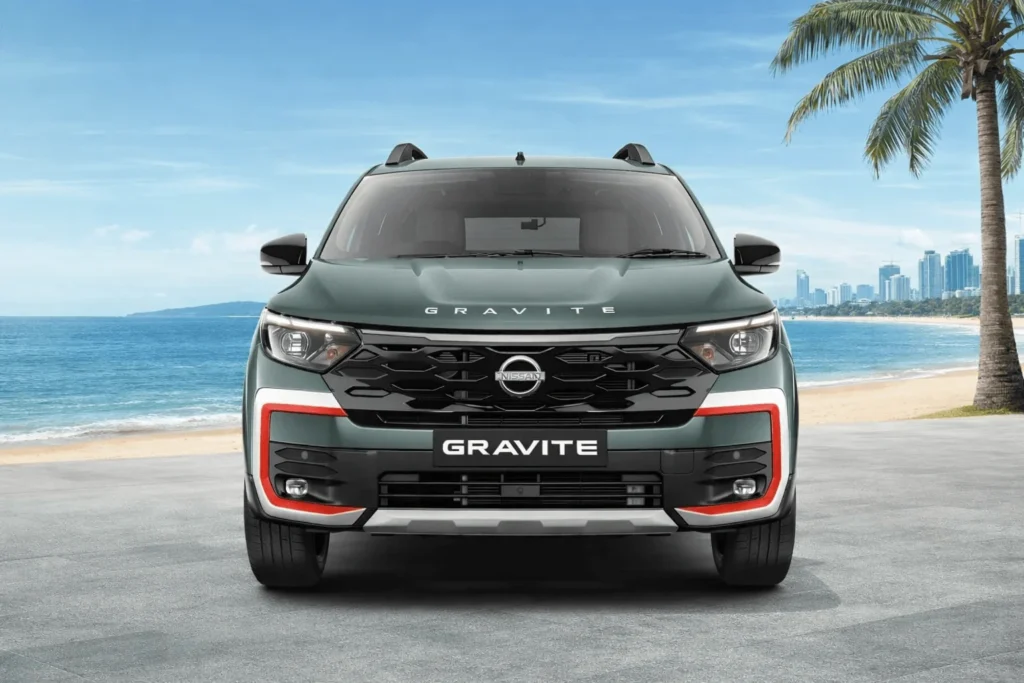
The Gravite is based on the same underlying platform as the Renault Triber, making it Nissan’s first model under the company’s new product strategy for the Indian market. DriveSpark Launched at an aggressive entry price of ₹5.65 lakh (ex-showroom), it’s positioned to attract first-time SUV/MPV buyers without stretching their budgets.
Key facts about the Gravite:
- Shares platform and powertrain architecture with Renault Triber
- Offers a revised exterior design with new bumpers and distinct lighting
- Builds off the momentum of the Magnite, which is already exported from India to several markets.
- Competes directly with the Renault Triber in the budget 7-seater MPV category
2. Nissan Tekton — The Creta Fighter That Looks Like a Baby Patrol
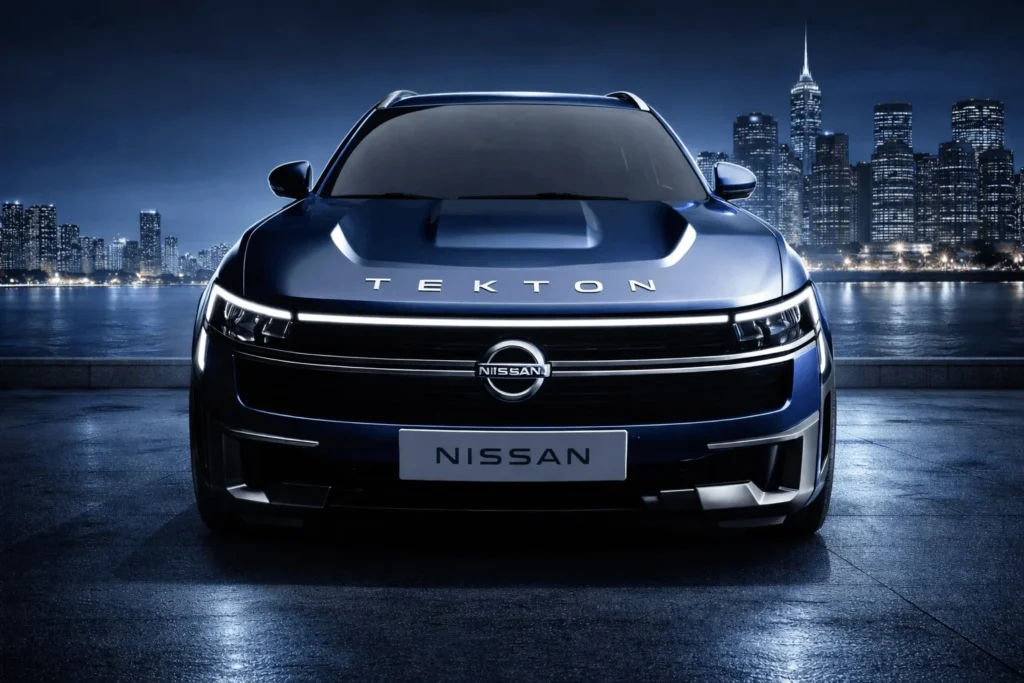
The Tekton is the model Nissan is betting its mid-term India future on. Slated for a mid-2026 debut, the Tekton is underpinned by the Renault Global Modular Platform (RGMP), a foundation it shares with the latest Renault Duster. Despite sharing mechanical foundations with the Duster, the Tekton carries a highly distinct visual identity inspired by the global Nissan Patrol.
Tekton design highlights:
- Full-width LED light bars at front and rear
- C-clamp signature DRLs echoing the Patrol’s design language
- Squared-off wheel arches with 18–19-inch alloy wheels
- Boxy, commanding silhouette targeted at younger urban buyers
Tekton engine options (expected):
- 1.0L Turbo Petrol — ~100 hp (entry variant)
- 1.3L Turbo Petrol — ~163 hp with 250 Nm torque
- 1.8L Strong Hybrid — ~160 hp combined output
Who will it compete with? The Tekton enters one of India’s most fiercely competitive segments, going up against: Hyundai Creta, Kia Seltos, Tata Sierra, and Volkswagen Taigun.
3. 7-Seater C-SUV — The Family Flagship for 2027
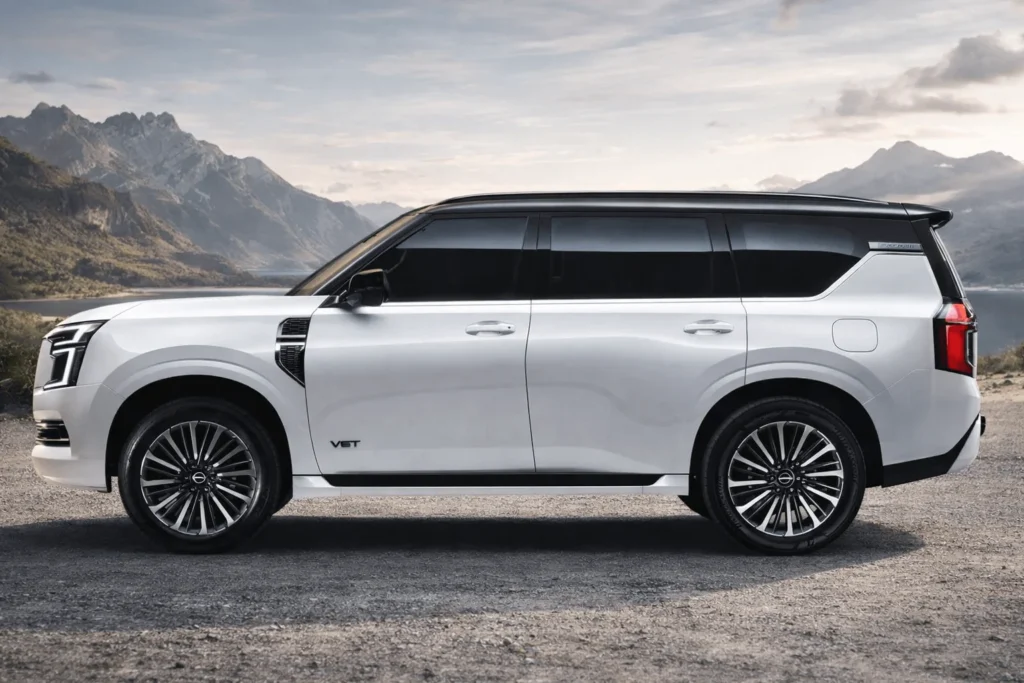
A new 7-seater SUV based on the Tekton’s RGMP platform is expected to launch in the first half of 2027. The SUV will have a longer wheelbase than the Tekton and is expected to measure around 4.5–4.6 meters in length. CarLelo It will share some body panels with the upcoming Renault Bigster, providing Renault-Nissan alliance synergies while maintaining differentiated branding.
4. Nissan Patrol — The Iconic Flagship, Coming to India
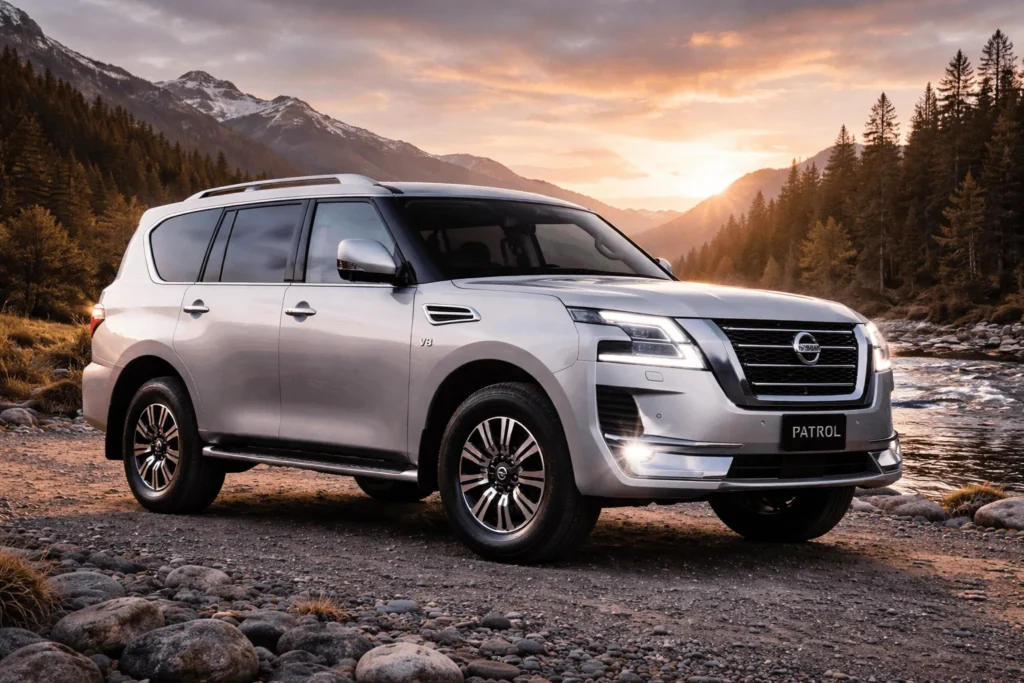
Perhaps the most exciting announcement for enthusiasts: the legendary Patrol may finally arrive in India. It is evaluating the introduction of the Patrol in India via the Completely Built Unit (CBU) route. The company would use India’s homologation-free import limit, which allows up to 2,500 vehicles per year. Nissan has also discussed the Patrol with its dealer partners in India, and their response has been positive. The SUV could be launched towards the end of this year or early next year.
The Patrol is a global icon — a dominant force in Middle Eastern markets — and its India entry, even at low volumes, would dramatically boost Nissan’s brand prestige.
The Manufacturing & Export Equation
One of the smartest pivots in Nissan’s India strategy is its asset-light operational model. After divesting its stake in the Chennai manufacturing JV to alliance partner Renault, Nissan retained a production reservation agreement.
What the Chennai factory deal means:
- Nissan has a contractual reservation of up to 2.5 lakh units per year from the Chennai plant
- The agreement runs until 2029, with an option to renew
- Both companies benefit from economies of scale and shared infrastructure
This arrangement lets Nissan sell in India and export at scale — without carrying the full capital burden of running a plant independently.
Electrification Strategy: Hybrids and Range Extenders First
Nissan is not jumping straight to pure EVs in India. Instead, the company is taking a pragmatic, infrastructure-aware approach. Massimiliano Messina, AMIEO Chairperson, confirmed that Nissan will introduce range extender technology and hybrids as part of its India electrification roadmap. His reasoning is pointed: building a full EV charging infrastructure across India requires enormous public and private investment, and range extenders bridge the gap far more cost-effectively for most buyers today.
It is also advocating for carbon credit benefits for hybrid and range extender vehicles — arguing that government policy should recognise these technologies as legitimate stepping stones toward full electrification.
Retail Network Expansion: From 155 to 250 Outlets
A product offensive is only as good as the distribution network supporting it. Nissan is looking to expand its sales network from 155 to 250 outlets by the end of FY27 freepressjournal — a near-doubling that signals serious intent to reach tier-2 and tier-3 cities where India’s next wave of SUV buyers is emerging.
Investment Commitment: “Several Hundred Millions”
Guillaume Cartier, Chief Performance Officer at Nissan Motor Corporation, made the financial commitment explicit: “The investments that we are doing are in several hundred millions (dollars) with the new models.”
This is not a token presence strategy. Nissan is committing capital at a scale that would be difficult to walk back — and Cartier acknowledged as much: “Our ambition is to stay and develop in India. If I was not committed, we would’ve exited. But that will not happen.”
Key Takeaways: What This Means for Indian Car Buyers
- More choice at every price point: From ₹5.65 lakh (Gravite) to flagship Patrol pricing, Nissan is finally building a full funnel.
- Stronger value proposition: Alliance-platform synergies mean competitive pricing without compromising on features.
- Better resale and service confidence: A wider dealer network reduces the after-sales risk that has historically deterred Nissan buyers.
- Electrification without EV anxiety: The hybrid-first approach addresses real infrastructure limitations.
The Bottom Line
Nissan’s India comeback isn’t a gamble — it’s a calculated, well-funded, alliance-backed strategy. With four distinct models across different price bands, a manufacturing deal that gives it production flexibility, and a retail network doubling in size, Nissan is better positioned than it has been in nearly a decade to claim meaningful market share in India.
The real question is execution. Can it price the Tekton aggressively enough to prise buyers away from the entrenched Creta and Seltos? Will the Patrol generate the aspirational halo effect the brand needs? And will the electrification roadmap keep pace with India’s evolving EV policy?
What do you think — is Nissan’s India comeback strategy the real deal, or is it too little, too late? Share your views in the comments below.
