

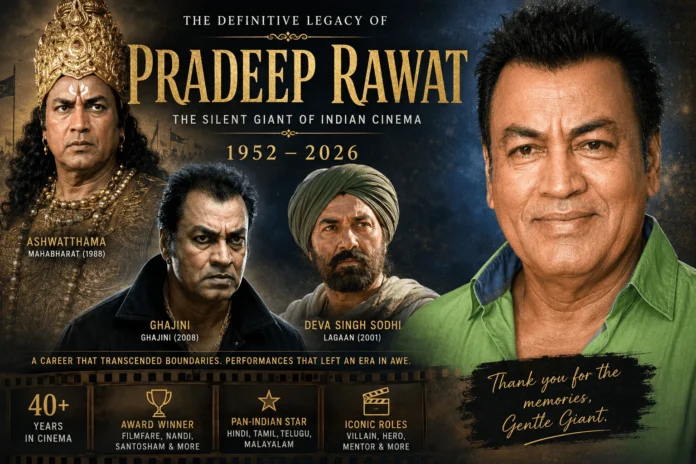
The passing of Pradeep Rawat on August 4, 2026, marked the end of a remarkable four-decade journey that spanned the golden age of television and the modern era of the 100-crore blockbuster. Known for his towering physique and a gaze that could convey more than pages of dialogue, Rawat was a “Pan-Indian” star long before the term became a marketing staple.
The Banker from Jabalpur: A Foundation of Discipline
Born on January 21, 1952, in Jabalpur, Madhya Pradesh, Pradeep Ram Singh Rawat’s path to the silver screen was far from conventional. Unlike the star kids of Mumbai, Rawat’s early life was defined by the stability of a government job. He served as a banker at UCO Bank, a role that demanded precision, punctuality, and a meticulous nature—traits that would later become his professional hallmarks in the film industry.
Colleagues often remarked that Rawat approached a film set with the same organizational rigor he used at the bank. He was famously known as the actor who was never late and the performer who arrived on set with every line of dialogue—even those in languages he didn’t speak—committed perfectly to memory.
Ashwatthama: The Role That Defined a Generation
In 1988, India came to a standstill every Sunday morning for B.R. Chopra’s Mahabharat. While the leads became icons, it was Pradeep Rawat’s portrayal of Ashwatthama that provided the series with its brooding, tragic intensity.
As the immortal son of Dronacharya, Rawat managed to capture the duality of a warrior—his loyalty, his internal torment, and his eventual descent into vengeance. This role didn’t just make him a household name; it established him as an actor who could dominate a scene through physical presence and atmospheric tension.
The Linguistic Chameleon: Breaking Regional Barriers
Perhaps Rawat’s greatest professional achievement was his seamless transition into South Indian cinema. In an industry where linguistic barriers often pigeonhole actors, Rawat became a staple in Telugu, Tamil, and Malayalam films.
His secret was a self-developed phonetic system. Despite not being a native speaker, he would spend hours with tutors to understand the rhythm and inflection of his lines. This dedication led to his historic “Triple Crown” in 2004 for his role as Bikshu Yadav in S.S. Rajamouli’s Sye. By winning the Filmfare, Nandi, and Santosham awards in a single year, he proved that a “villain” could be just as celebrated as a “hero” if the performance was sufficiently visceral.
The ‘Ghajini’ Phenomenon and Global Recognition
While he was a celebrated antagonist in the South, his return to Bollywood in 2008 with Ghajini cemented his status in the history books. Playing the titular Ghajini Dharmatma, Rawat was the perfect foil to Aamir Khan’s transformative protagonist. The film became the first Indian production to cross the ₹100 crore mark, and Rawat’s performance was so essential that he was the only major cast member to play the role in both the original Tamil version (2005) and the Hindi remake.
Earlier, in 2001, he had already tasted global acclaim with Lagaan. As Deva Singh Sodhi, the Sikh sepoy who joins Bhuvan’s cricket team, he showcased a rare heroic side. The film’s Academy Award nomination for Best Foreign Language Film took Rawat to the global stage, proving his versatility beyond the “villain” archetype.
The Disambiguation of a Legacy
In the digital age, Pradeep Rawat’s name often appeared in search results alongside two other prominent Indians:
- The Actor: Pradeep Ram Singh Rawat, the subject of this tribute.
- The Diplomat: Ambassador Pradeep Kumar Rawat (IFS), a key figure in India-China relations.
- The Politician: Pradeep Trimbak Rawat, the former MP from Pune and environmentalist.
While their fields were vastly different, the actor often joked that the discipline required for diplomacy and the public service of politics weren’t entirely foreign to the world of a character actor who had to serve the vision of a director.
A Courageous Final Act
The final five years of Rawat’s life were a testament to his endurance. Diagnosed with leukemia, he chose to keep his battle largely private, continuing to work even while undergoing treatment. His appearances in Waltair Veerayya (2023) and the posthumous release Chhaava show a man who remained dedicated to his craft until the very end.
He is survived by his wife, Kalyani, and his two sons, Vikram and Singh. To the film world, he remains the “Gentle Giant”—a man whose on-screen menace was a stark contrast to his off-screen humility and kindness.
Extended Filmography Highlights
- 1980s: Meri Jung, Mahabharat (TV)
- 1990s: Koyla, Sarfarosh
- 2000s: Lagaan, The Hero, Sye, Ghajini (Tamil & Hindi)
- 2010s: Veeram, Sarrainodu, Nene Raju Nene Mantri
- 2020s: Waltair Veerayya, Chhaava
