

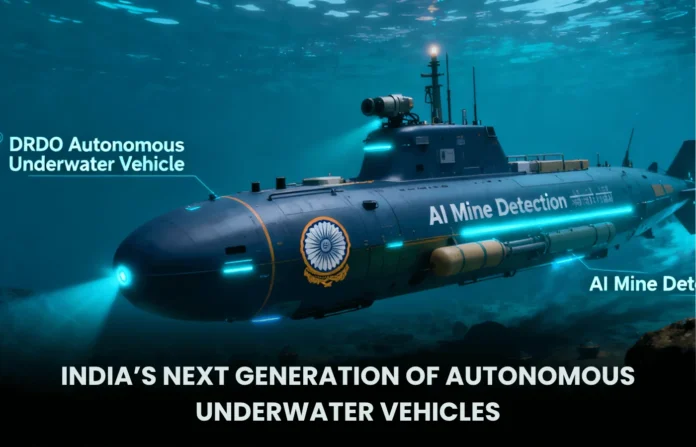
Autonomous Underwater Vehicles: A Great Leap
India’s maritime security infrastructure has taken a significant leap forward with the Defence Research and Development Organisation (DRDO) unveiling a new fleet of man-portable autonomous underwater vehicles (MP-AUVs), purpose-built for naval mine detection and countermeasure operations. This homegrown innovation promises to fill a longstanding gap in India’s underwater defense capabilities while introducing features such as artificial intelligence, collaborative robotics, and instantaneous data analysis.
Mine Warfare: A Persistent Challenge
Naval mines remain one of the most cost-effective and dangerous threats in modern maritime environments. These hidden dangers can disable warships, submarines, and merchant vessels, putting strategic shipping routes and naval assets at risk. Historically, the Indian Navy relied on specialized mine countermeasure vessels (MCMVs), which utilized sonar, remotely operated vehicles, and divers for mine detection and removal.
However, after the retirement of India’s older minesweeper ships, the Navy was left vulnerable. This problem was further compounded by increased underwater activity from China and Pakistan in the Indian Ocean Region. Recognizing the urgency, the Defence Acquisition Council approved plans for twelve new mine countermeasure vessels, but the need for an immediate, effective technological solution remained.
DRDO’s Strategic Response: Man-Portable AUVs
To address these challenges, the Naval Science and Technological Laboratory (NSTL) in Visakhapatnam spearheaded the development of a new breed of man-portable AUVs for mine countermeasure missions. Unlike conventional systems, these vehicles are compact, portable, and can be rapidly deployed from ships, docks, or shorelines. They are designed to operate independently or as coordinated teams. Their modular construction considerably reduces logistics requirements, enabling swift response even in remote or resource-limited environments.
Technological Innovations: Sensors, Artificial Intelligence, and Networked Collaboration
The backbone of the system comprises advanced side-scan sonar and underwater cameras. The side-scan sonar creates highly detailed acoustic maps of the seabed, allowing for accurate mine detection. These maps are processed using onboard deep learning algorithms, enabling the vehicles to autonomously recognize and classify objects in real time. This use of artificial intelligence means mine detection no longer relies exclusively on human operators, which reduces error, expedites decision-making, and minimizes risk.
A robust underwater acoustic communications system ensures the AUVs can share data and coordinate movements in real-time. This ability to operate as a collaborative network enhances detection accuracy, allows vehicles to pool sensor data for a multi-perspective analysis, and provides mission controllers with unprecedented situational awareness.
Field Trials and Industry Partnership
The MP-AUV system has recently passed rigorous trials at NSTL’s harbor facilities, demonstrating reliable mine-like object detection and operational readiness. This validation marks a major step forward. According to DRDO leadership, industry partners across India are engaged in scaling production and integrating these systems for broader naval use, with full deployment likely in the near future.
Strategic Significance for India’s Naval Defense
As the Indian Navy inducts new mine countermeasure vessels into service, these autonomous vehicles will serve as force multipliers. Integration with future MCMVs will enable rapid, safe mine-hunting operations and ensure greater protection for fleet movements and commercial shipping. Their autonomous and collaborative design heralds faster area clearance and reduces operational risk, while ongoing modular upgrades will allow continuous improvement as new technologies emerge.
Beyond military use, the research and infrastructure created for these AUVs opens the door for wider applications, including underwater exploration, search and rescue missions, and environmental monitoring.
A Leap Ahead in Maritime Artificial Intelligence
Globally, incorporating intelligent autonomous vehicles in mine warfare sets the benchmark among leading navies. By developing these systems in-house, India cements its position among technologically advanced maritime nations. As the MP-AUV fleet expands, India will be better equipped to safeguard vital sea lanes and coastal regions, project power, and lead in underwater technology innovation.
Conclusion
DRDO’s introduction of man-portable autonomous underwater vehicles marks a landmark achievement and a timely solution to an urgent defense need. These new systems, powered by advanced sensors and AI algorithms, offer rapid, reliable mine detection and set a new standard for operational efficiency and safety. As production scales and operational deployment begins, India’s naval forces gain a powerful edge in securing their maritime boundaries and embracing the future of autonomous defense technology.
