

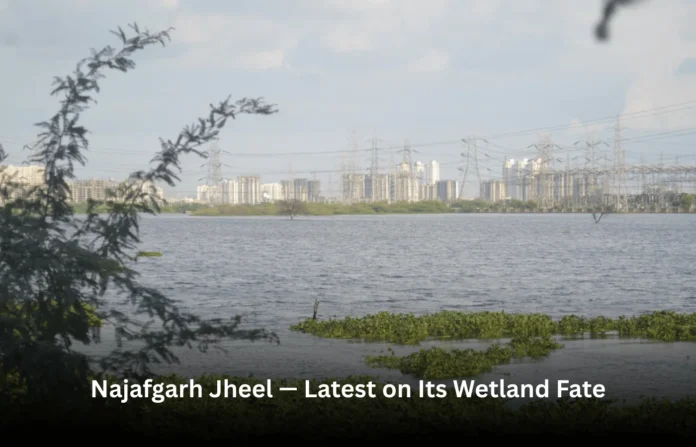
The saga of Najafgarh Jheel — a historically vast lake spanning parts of Delhi and Haryana — may finally be inching toward closure after more than a decade of legal and environmental back-and-forth. In a recent session on November 26, 2025, the National Green Tribunal (NGT) accepted a submission from the Ministry of Environment, Forest and Climate Change (MoEFCC): an interim demarcation and wetland-notification report prepared by Wetlands International South Asia (WISA) and WWF India is ready. However, the ministry clarified that this report has to be revalidated by an independent institution before final submission — expected in February or March 2026.
Here’s a comprehensive breakdown of where things stand, why this matters, and what could come next.
What Is Najafgarh Jheel — A Quick Recap
- Historically, Najafgarh Jheel was a large natural lake fed by the Sahibi River. Over decades, interventions by the flood-control authorities led to its draining. What remains today is largely the Najafgarh Drain, which carries sewage and runoff rather than natural inflows.
- Despite its degraded state, the jheel and drain area continue to play an important ecological role — acting as a groundwater recharge zone, a buffer against floods, and a habitat for birds and other species. According to the 2022 Environment Management Plan (EMP), these ecosystem services remain crucial for Delhi–Haryana region
- Additionally, the area has been a refuge for migratory waterbirds during winters, making it significant for biodiversity and urban ecology.
Given these factors, the jheel qualifies as a wetland under the rules framed by the Wetlands (Conservation and Management) Rules, 2017 — which mandate protective measures for such ecosystems.
Why Has Official Notification Been Delayed?
Though recognition seems overdue, several obstacles have prevented the official designation of Najafgarh Jheel as a notified wetland:
Diverging Area Estimates
- The two states involved — Delhi and Haryana — have differed widely in their claims about how much area should be notified. Under the 2022 EMP, they had delineated a total wetland area of 2,530 hectares: 1,400 ha in Delhi and 1,130 ha in Haryana.
- But in its latest affidavits, Haryana’s Wetland Authority has insisted on recognizing just 30 hectares in its jurisdiction — a figure strongly contested by conservationists.
- According to the Indian National Trust for Art and Cultural Heritage (INTACH) — which filed the original petition in 2018 — historical maps and satellite imagery from various years show the jheel inundated over several hundred to a few thousand acres in Haryana alone.
Legal and Procedural Hurdles
- In 2023, the Supreme Court of India set aside a previous order of the NGT, ruling that the case related to rejuvenation of Najafgarh Lake should be heard along with all other pending petitions — effectively freezing any separate decisions on it.
- In light of these overlaps and objections, the NGT in May 2025 directed the National Wetland Authority (NWA) to conduct an independent third-party audit to resolve the conflicting area estimates.
- Meanwhile, rapid urbanization, sewage inflow, and encroachments have further complicated ground realities — making ecological assessments and demarcation challenging.
What Happened in the November 26, 2025 NGT Hearing
The hearing held on November 26 added a new chapter to the long-standing saga:
- MoEFCC informed the tribunal that the joint field-survey by WISA and WWF India has been completed (in August 2025), resulting in an interim report for demarcation. However, they said it must be revalidated by NWA’s counterpart, National Centre for Sustainable Coastal Management (NCSCM), before final submission — which is expected in February or March 2026.
- The tribunal accepted this timeline and granted the ministry extra time. While the interim report was due by November 29, Justice Prakash Shrivastava — chairperson of the NGT bench — permitted additional time for finalization.
- This step is significant because once the report is submitted and accepted, both Delhi and Haryana will have to officially notify the wetland for legal protection — paving the way for conservation, anti-encroachment measures, and habitat restoration.
Why This Decision Matters — Beyond Maps and Legalities
Designating Najafgarh Jheel as a protected wetland isn’t just a bureaucratic formality. It carries deep ecological, social, and long-term urban resilience implications:
- Ecological Restoration: A notified wetland status can trigger steps for restoration of water quality, control of sewage inflows, and reinstatement of natural hydrology — helping revive groundwater recharge, biodiversity, and flood buffering capacity.
- Habitat for Migratory Birds and Wildlife: Numerous species — including migratory waterbirds — depend on this ecosystem during winters. Legal protection can safeguard these habitats from further degradation.
- Climate Resilience & Flood Control: Wetlands act as natural sponges, absorbing excess rainwater and preventing urban flooding. Given rising climate risks, restoring such wetlands becomes critical for Delhi–Gurugram region’s resilience.
- Urban Planning & Public Health Benefits: Cleaned and protected wetlands can help in groundwater recharge and reducing pollution — benefits that echo through water supply, irrigation and overall urban well-being.
What’s Still Unclear & What to Watch
While the recent development seems promising, several uncertainties remain:
- The actual wetland area to be notified — especially on Haryana’s side — depends on NCSCM’s revalidation and final agreement between Haryana and Delhi. Given the history of conflicting claims, this may again become contentious.
- Even after legal notification, effective on-ground implementation is not guaranteed. Past experience in India reveals that wetlands often continue to suffer neglect, pollution and encroachment despite legal status.
- Restoration and ecological recovery — if planned — will require sustained monitoring, maintenance, and likely, civic engagement; otherwise, the jheel might remain a “paper wetland” without real ecological benefits.
What This Means for Locals, Conservationists and Policy-Makers
For residents of Delhi, Gurgaon, and surrounding regions — and for environmental advocates — the latest NGT order is a cautiously optimistic sign. If the upcoming revalidated report leads to official notification, it could mark the beginning of a long-overdue restoration journey for one of the region’s most important natural water bodies.
For policy-makers, this is a chance to demonstrate that environmental laws (like the Wetlands Rules, 2017) can be enforced meaningfully, not just relegated to files. For civil-society groups, it may provide a platform to push for ecological restoration, public awareness and habitat conservation.
