

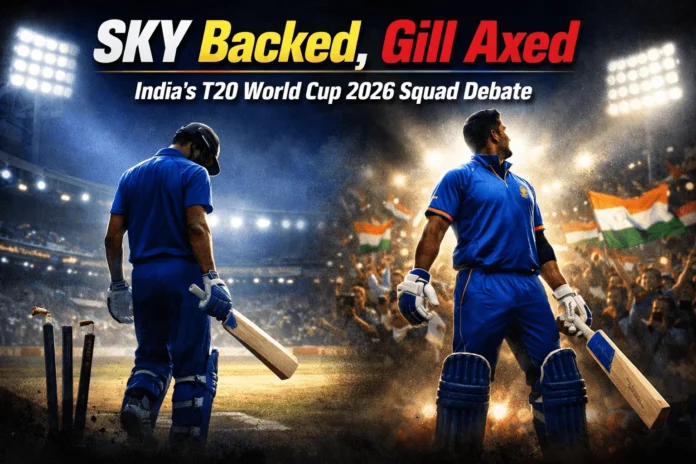
India’s T20 World Cup 2026 squad announcement has reignited the selection debate in Indian cricket, with in-form opener Shubman Gill missing out while out‑of‑form skipper Suryakumar Yadav continues to enjoy the full backing of the selectors and team management.
India’s T20 World Cup 2026 Squad: 15 for home T20 World Cup
India, the defending champions and co‑hosts, have confirmed a 15‑member squad for the ICC Men’s T20 World Cup 2026, which begins on 7 February on home soil.
Suryakumar Yadav has been retained as captain for his first ICC event at the helm, with Axar Patel appointed as vice‑captain in a side built around continuity, multi‑role options and home‑condition strengths.
The full squad reads: Suryakumar Yadav (c), Abhishek Sharma, Tilak Varma, Sanju Samson, Shivam Dube, Ishan Kishan, Hardik Pandya, Arshdeep Singh, Jasprit Bumrah, Harshit Rana, Varun Chakaravarthy, Kuldeep Yadav, Axar Patel (vc), Washington Sundar, Rinku Singh.
Gill’s surprise omission and selector logic
Shubman Gill’s exclusion is the headline call, especially after he was brought back into the T20I setup earlier this year and entrusted with leadership responsibilities as T20I vice‑captain in the build‑up phase.
Despite his reputation as a future all‑format mainstay, Gill’s T20I returns since his recall have been modest, with fewer than 300 runs at an average in the mid‑20s and a prolonged drought of impactful scores.
Chief selector Ajit Agarkar has pointed to team balance and role‑specific demands as key reasons, stressing that India were looking for ultra‑aggressive powerplay batting and additional utility in the top order.
With multiple top‑order candidates available, the panel prioritised players who either attack from ball one or add wicketkeeping or all‑round value, a criteria that ultimately pushed Gill outside the final 15 despite his class and long‑term value.
New‑look top order and batting strategy
India’s top‑order template for this World Cup clearly leans towards high‑risk, high‑reward batting rather than accumulative play.
Explosive left‑hander Abhishek Sharma, who has built a reputation in domestic cricket and the IPL with a strike rate near 190, is expected to provide early momentum as a specialist powerplay hitter.
Sanju Samson is likely to partner Abhishek at the top, offering clean hitting, experience and wicketkeeping, making him a flexible tactical piece in the XI.
Ishan Kishan strengthens this template as a backup opener–keeper after a standout Syed Mushtaq Ali Trophy campaign, where he led Jharkhand to the title and smashed over 500 runs at a strike rate around 200, showcasing the exact fearless approach the selectors wish to replicate at the international level.
Behind them, the middle order is stacked with floaters and finishers: Suryakumar Yadav, Tilak Varma, Rinku Singh, Shivam Dube, Hardik Pandya, Axar Patel and Washington Sundar can all move up or down depending on match situation, opposition and conditions.
This structure is designed to ensure there is always at least one left‑hander at the crease and multiple players capable of clearing the ropes from the outset, a clear tactical evolution from India’s more conservative past T20 templates.
Bowling attack built around Bumrah and spin depth
On the bowling front, Jasprit Bumrah remains the undisputed spearhead, expected to anchor powerplay, middle overs and death phases with his proven big‑tournament temperament.
Arshdeep Singh’s left‑arm angle and new‑ball swing, along with Harshit Rana’s hit‑the‑deck pace, round out a pace group that will be supported by the seam‑bowling all‑round skills of Hardik Pandya and, at times, Shivam Dube.
Conditions in India have prompted a spin‑heavy strategy, with Kuldeep Yadav’s wrist‑spin, Axar Patel’s stump‑to‑stump accuracy, Washington Sundar’s powerplay control and Varun Chakaravarthy’s mystery spin giving India a varied attack tailored to slow or gripping surfaces.
This mix allows India to field three specialist spinners if needed or balance two spinners with a deep batting lineup through Axar and Washington, who both lengthen the order.
How Suryakumar keeps getting chances despite poor form
Suryakumar Yadav’s place and captaincy have become central to the debate, with his individual form under intense scrutiny over the past year.
Across 2025, he has endured a difficult run in T20Is, ending the year without a single half‑century and averaging in the low‑teens, a stark contrast to his earlier phase as the world’s top‑ranked T20I batter.
Despite this slump, selectors and management have repeatedly backed him, stressing both his historical numbers and his match‑winning ceiling in the format.
Over his T20I career, Suryakumar still averages above 35 at a strike rate north of 160, numbers few batters in world cricket can match, and his ability to access unconventional areas has previously dismantled top attacks.
Leadership stability is another major reason he continues to be trusted; since taking over as T20I captain after India’s previous T20 World Cup triumph, the BCCI has been reluctant to trigger a leadership change just before another global event at home.
Support staff and former players have argued that with a strong bowling attack and deep batting cast around him, India can afford to persist with Suryakumar in the hope that familiar home conditions and a clear role will help him rediscover rhythm at the right time.
At the same time, his extended run, despite a year‑long fifty drought, has fuelled fan frustration and talk of double standards, especially when contrasted with the treatment of players like Gill, who have been dropped after lean patches.
For now, though, the message from the selection table is unambiguous: Suryakumar remains central to India’s T20 vision, and the World Cup at home may be his defining examination as both batter and leader.
Big calls, high stakes
The squad India have chosen for the 2026 T20 World Cup reflects a bold, role‑driven approach that sacrifices some established names to chase a more aggressive template.
Gill’s omission and Suryakumar’s continued backing encapsulate the tension between form, potential and faith in past performances, ensuring that every outing in this World Cup will be viewed through the lens of these contentious decisions.
