

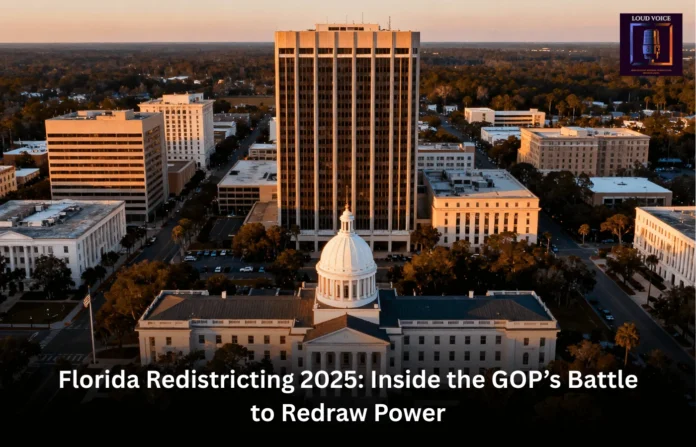
Florida Redistricting 2025: The Political Earthquake in Florida
Florida’s political map may soon get a dramatic makeover. As part of a rare mid-decade redistricting effort, state leaders are preparing to redraw congressional districts — a move that could cement Republican control of the U.S. House or risk deep legal battles.
The Florida redistricting 2025 process isn’t happening in a vacuum. Across the country, both red and blue states are scrambling to reshape electoral boundaries ahead of the 2026 midterms. Yet, Florida stands out — not just for its partisan edge, but because internal divisions, constitutional limits, and court rulings could redefine how far the GOP can go.
For Republicans, this is high-stakes chess. For Democrats, it’s a looming storm that could erode representation in one of the nation’s most politically influential battlegrounds.
Why Florida’s Redistricting Matters Now
Florida is the third-most populous state, boasting 28 congressional districts. Republicans currently hold 20 of them. With national power hinging on single digits in the House, picking up even two or three additional seats in Florida could reshape the national landscape for years.
But while the White House has encouraged GOP-led legislatures to accelerate redistricting, the Sunshine State’s process has lagged behind. Legal constraints, constitutional checks, and fiery exchanges between Gov. Ron DeSantis and state lawmakers have slowed what was expected to be a smooth power play.
“Florida could deliver the final boost Republicans need heading into the midterms,” said a GOP strategist familiar with the process. “But the state’s constitutional framework makes it tricky. Push too far, and it could backfire in court.”
How We Got Here: A Mid-Decade Political Gamble
Redistricting traditionally happens after the once-a-decade census. However, the current wave — occurring mid-decade — is unprecedented. Sparked by Republican efforts in states like Texas, Missouri, and North Carolina, mid-decade redistricting has become both a strategic weapon and a legal minefield.
Florida formally entered the game this December with a legislative hearing in Tallahassee. This kickstarted a months-long process expected to run into early 2025.
The stakes are enormous. The GOP hopes to strengthen its slim U.S. House majority, especially after mixed outcomes in other Republican-led states. Yet the move is fraught with political and constitutional hazards that make Florida’s case uniquely complex.
The DeSantis Factor: Pressure and Pushback
Governor Ron DeSantis has championed redistricting since his rise to national prominence. However, his relationship with the state legislature has grown tense over when and how to execute the plan.
DeSantis wants a special legislative session in April 2025, strategically close to the April 20 qualifying deadline for congressional candidates. He argues that waiting for the U.S. Supreme Court’s upcoming decision on the Louisiana Voting Rights Act case could justify drawing a new map.
“If the Court weakens the Voting Rights Act further, it will necessitate new congressional redistricting,” DeSantis said during a recent press conference in Tallahassee.
But state House leaders, wary of legal fallout and tight timelines, strongly disagree. “It would be irresponsible to delay,” said State Rep. Mike Redondo, chair of the House Redistricting Committee. “Citizens deserve transparency and stability before the filing deadlines.”
Their dispute underscores a deeper power struggle — one between DeSantis’s agenda-driven executive strategy and lawmakers aiming for a disciplined, legally safe process.
Public Frustration and Transparency Concerns
At the first redistricting hearing, dozens of activists, community leaders, and voters converged in Tallahassee. Many left angry. The meeting, lasting just over an hour, offered zero time for public comment — a decision that triggered laughter and frustration among the audience.
“There was no opportunity for citizens to speak,” noted Jessica Lowe-Minor, president of the Florida League of Women Voters. “People traveled long distances to be heard. It feels dismissive.”
Activists fear that public exclusion could mask partisan maneuvering. Although Republican leaders insist that politics won’t dictate the redraw, skepticism remains high. “This process was never meant to be neutral,” said one attendee. “It’s about shaping power, not just maps.”
Legal Boundaries: Florida’s Anti-Gerrymandering Clause
Florida’s Constitution contains a unique provision — the Fair Districts Amendment — which prohibits redrawing boundaries to benefit or harm a political party or incumbent. Though critics claim recent judicial interpretations have softened its teeth, the clause still poses a major obstacle to any overtly partisan map.
Legal scholars predict inevitable challenges if the GOP overreaches. Even a net gain of five seats, insiders admit, could trigger lawsuits alleging violations of the Fair Districts Amendment and the federal Voting Rights Act.
“There’s a fine line,” warned a veteran Republican operative speaking anonymously. “Pushing for too many seats could land us right back in court, and that helps no one.”
The Broader Republican Strategy — And Its Limits
Florida’s move fits into a larger national effort aimed at shoring up Republican districts in swing regions. However, the initiative has produced uneven results:
- Texas successfully implemented a map giving Republicans up to five additional seats after the Supreme Court allowed it for midterms.
- Indiana gained approval for a two-seat bump though internal party divisions persist.
- Ohio negotiated a compromise that stopped short of Democratic fears.
- Utah saw a court-ordered redraw benefiting Democrats instead of the GOP.
Meanwhile, Democratic-leaning states such as California, Virginia, Illinois, and Maryland have advanced their own redistricting adjustments to counterbalance Republican gains. The result is a nationwide tug-of-war over political representation — one that will define the 2026 midterm narrative.
How Many New Seats Could Florida Gain?
According to experienced GOP insiders, Florida’s new map could feasibly deliver between three to five additional Republican seats. That outcome would tilt the state’s delegation to as many as 25 out of 28 seats — an enormous margin that would virtually guarantee Florida’s status as a Republican stronghold.
However, insiders admit that chasing the high end of that estimate — five seats — carries serious legal risk. The courts have historically scrutinized Florida’s maps closely, often forcing revisions.
“It’s a question of balance,” said a strategist close to the DeSantis administration. “We want gains that last — not wins that get tossed out by the courts.”
Potentially vulnerable Democratic-held districts include:
- Rep. Darren Soto’s Orlando-area seat
- Rep. Jared Moskowitz’s South Florida district
- Rep. Debbie Wasserman Schultz’s Miami-area territory
If two or three of this flip red, the national GOP could secure its House majority even under adverse conditions elsewhere.
The National Ripple Effect
The Florida redistricting 2025 saga isn’t isolated — it has national implications that could determine political control through 2030. For decades, Florida has oscillated between battleground and stronghold status. Today, the state stands as a cornerstone of Republican dominance, yet its legal and demographic complexities keep it unpredictable.
Political analytics firm FiveThirtyEight estimates that a favorable Florida map could deliver Republicans up to a net 2% nationwide advantage in total House seats — enough to flip control in a close midterm.
Democrats, meanwhile, are arming themselves for a court battle. Progressive groups plan to monitor the redistricting hearings and file preemptive challenges if partisan intent is suspected. Past victories under Florida’s constitutional protections, including the landmark 2015 case that overturned GOP-drawn maps, suggest history could repeat.
What the Supreme Court Could Decide Next
All eyes are now on Washington as the U.S. Supreme Court’s Louisiana redistricting case nears resolution. At issue is whether eliminating certain racial protections under the Voting Rights Act is constitutional — a move that could empower states like Florida to redraw minority-majority districts.
If the Court weakens federal oversight, Florida Republicans could gain broader legal leeway to consolidate GOP-friendly districts, especially in South and Central Florida. Civil rights advocates warn this could disenfranchise Black and Hispanic voters whose districts were protected under federal law for decades.
“This case isn’t just about Louisiana — it’s about the future of equal representation,” said Heather Cox, a legal analyst at Georgetown University. “Florida’s next map will either set a precedent for compliance or defiance.”
The Road Ahead: What to Expect in 2025
The redistricting calendar will move quickly once lawmakers reconvene in early January. Here’s how analysts expect the process to play out:
- January–March 2025: Regular legislative session debates potential frameworks and gathers public feedback.
- April 2025: Possible special session convenes under DeSantis’s direction, aligning with the Supreme Court’s ruling timeline.
- May–June 2025: Legal challenges likely emerge, particularly if the final map deviates sharply from proportional fairness standards.
- Summer 2025: Courts review and potentially approve final districts before candidate filings close for federal races.
The compressed timeline leaves little room for error — or transparency missteps.
Florida’s Political Identity at a Crossroads
Beyond numbers and laws, Florida’s redistricting fight is about identity. The state’s population is surging with Latino, Caribbean, and transplants from northern states, shifting its cultural and political makeup. Whether the new map reflects these realities or simply consolidates existing power structures will reveal much about Florida’s democratic health.
At a broader level, Florida redistricting 2025 symbolizes a recurring American tension — between partisan ambition and the constitutional promise of equal representation.
As one veteran observer put it, “Every map tells a story. The question is: will Florida’s next one tell a story of power — or fairness?”
Final Thoughts: The State to Watch in 2025
Florida’s next few months will be decisive not only for its residents but for U.S. politics overall. The outcome could tip the balance of Congress and reshape the narrative heading into the 2026 midterms.
Whether the process brings partisan gain or constitutional pain, one thing remains clear — Florida is once again the epicenter of America’s electoral future.
