

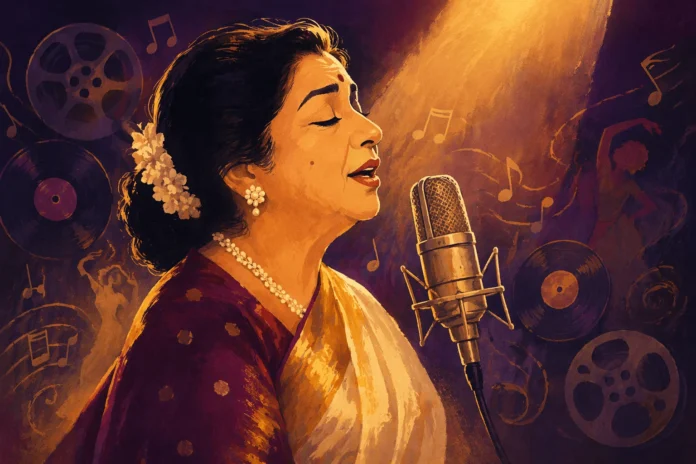
Mumbai, April 12, 2026 — Asha Bhosle, the playback phenomenon who stepped out from the long shadow of her sister Lata Mangeshkar to build her own, genre‑defying universe in Indian music, died in Mumbai on Sunday. She was 92.
For more than eight decades, Bhosle’s voice electrified, seduced, comforted and challenged generations of listeners, cutting across class, region and language to become one of the most familiar sounds in the country’s collective memory. From cabaret floors to courtesan mehfils, village fairs to urban discos, her songs mapped the changing desires and contradictions of modern India with an ease that no other playback singer quite matched.
Stepping out of a giant shadow
Born on September 8, 1933, into the musical Mangeshkar family of Sangli, Asha Bhosle’s destiny seemed pre‑written. Her father, Dinanath Mangeshkar, a classical singer and theatre actor, trained all his children in music; four of them went on to become respected singers and musicians in their own right.
Yet the path before Asha was anything but simple. As Lata Mangeshkar’s ethereal, note‑perfect voice rose to undisputed dominance in Hindi cinema, Asha was often initially cast as the younger sister who would sing for side heroines, vamp characters and low‑budget films, sometimes asked to approximate Lata’s tone rather than assert her own.
That script changed when composers like O. P. Nayyar and later R. D. Burman heard in her voice something different: a darker, more sensuous colour; a playful edge; and a rhythmic elasticity that could ride the new, beat‑driven soundtracks redefining Hindi film music. They gave her not Lata’s leftovers, but a completely new space — and she turned it into an empire.
Asha Bhosle: The queen of genres
Over the course of some 12,000 recorded songs in more than 20 Indian and foreign languages, Asha Bhosle sang almost everything a playback singer could possibly sing: filmi hits, pop, ghazals, bhajans, qawwalis, folk melodies, classical and semi‑classical compositions, even Rabindra Sangeet. Obituaries and tributes this week repeatedly return to a single word to describe her: versatile.
Her own discography offers the proof. She was the unmistakable voice of the cabaret and the vamp in “Piya Tu Ab To Aaja” and “Yeh Mera Dil,” tracks whose smoky sensuality would have jarred with Lata’s carefully protected “Melody Queen” image. She powered counter‑culture youth rebellion in the rock‑psychedelic anthem “Dum Maro Dum,” then pivoted effortlessly to syrupy romance in “Chura Liya Hai Tumne,” rustic swagger in “Mehbooba Mehbooba,” and haunting refinement in the Umrao Jaan ghazals “Dil Cheez Kya Hai” and “In Aankhon Ki Masti.”
Even in the 1990s and 2000s, when many of her contemporaries had retreated from centre stage, she was the energetic, teasing voice of “Rangeela Re” for A. R. Rahman and the folk‑flecked storyteller in “Radha Kaise Na Jale” from Lagaan, sounding far younger than her years. Late‑career projects such as the album 82 — ghazals by Suresh Bhat arranged with pop, reggae, blues and rock textures — showed that genre‑blending and risk‑taking were not youthful phases but lifelong habits.
The composers who unlocked her
If Asha Bhosle’s versatility was a many‑splendoured jewel, the music directors she worked with were the light sources that brought out different facets.
With O. P. Nayyar, who famously never used Lata, Asha became the beating heart of rhythm‑heavy, Punjabi‑folk‑inflected scores in films like Naya Daur, Tumsa Nahin Dekha and Mere Sanam. Nayyar relied on her ability to glide over pounding percussion, to flirt and tease with her phrases, and to infuse cabaret numbers with a dangerous gaiety that made them memorable but never cheap. Their songs re‑imagined her as the bold, urban, modern woman’s voice — a role Hindi cinema was just beginning to discover.
An estrangement between S. D. Burman and Lata in the late 1950s opened another door: Asha became his principal female singer for a time, and with that came tender, central romantic songs in films like Hum Dono that proved she could inhabit Lata’s core terrain of melodic heroine solos as convincingly as she did nightclub sequences.
The partnership that perhaps most defined her modern, experimental image was with R. D. Burman, whom she later married. Analysts estimate he wrote more songs for Asha than for any other female singer, including his sister‑in‑law Lata. Together, they expanded the grammar of Hindi film music — fusing Indian melody with jazz, rock, Latin and disco — and Asha met every experiment with a chameleon‑like change in tone and attack. Her voice snarls and seduces in “Aaja Aaja Main Hoon Pyar Tera,” turns psychedelic in “Dum Maro Dum,” growls with rustic bravado in “Mehbooba Mehbooba,” and floats butter‑soft in “Tu Tu Hai Wohi.”
If Nayyar and R. D. Burman used her to stretch Hindi film music towards Westernised modernity, Khayyam used her to prove that she could stand shoulder‑to‑shoulder with the best in semi‑classical and ghazal singing. In Umrao Jaan, her measured taans, delicate meends and the emotional stillness she brought to “Dil Cheez Kya Hai” and “Yeh Kya Jagah Hai Doston” gave Rekha’s courtesan the kind of musical inner life that earlier films had rarely attempted. Many critics today cite this as one of the greatest ghazal soundtracks in Hindi cinema history — and as a rebuke to the old stereotype of Asha as “only” a cabaret singer.
The craft behind the magic
What made all this possible was not just opportunity, but technique. Critics and fellow musicians often talk about Asha Bhosle’s voice in terms of colour, swing and micro‑expression.
Where Lata’s tone was famously thin, bell‑like and almost otherworldly, Asha’s soprano carried a darker, huskier, more “earthy” timbre that she could lighten or thicken at will. In one song she could sound like a starry‑eyed teenager; in another, a jaded cabaret dancer; in a third, a dignified courtesan or a village woman. Composers exploited this not just for melody but for character — the audience could often guess what kind of woman was on screen from the voice alone.
Her rhythmic agility was legendary. Fast tempos, syncopated accents, Western drum patterns and Latin‑style grooves, which might trip up less flexible singers, seemed to energise her. Songs like “Piya Tu Ab To Aaja,” “Aaja Aaja Main Hoon Pyar Tera” and “Mehbooba Mehbooba” are built on complex rhythmic play, yet her lines sit so naturally in the groove that the difficulty disappears behind sheer enjoyment.
Equally distinctive was her phrasing and ornamentation. In countless songs she uses small glides, quick turns and even tiny spoken interjections to build dramatic tension. “Piya Tu Ab To Aaja,” with its oscillation between breathless whispers, playful shouts and sung lines, is often cited as a masterclass in turning a film song into a mini theatrical performance. In her ghazals, by contrast, breath control and dynamics are deployed to serve the poetry — stretching a word here, caressing a consonant there — in ways that reveal a deep understanding of the text, not just the tune.
Studio anecdotes from R. D. Burman’s camps paint her not as a passive recipient of instructions but as an active collaborator who would suggest phrase‑endings, experiment with new textures and happily tackle unfamiliar rhythmic or stylistic challenges. This openness, musicians say, is what allowed her to travel smoothly from mono‑era live recordings to multi‑track pop, disco and synthesiser‑driven soundscapes without ever seeming out of place.
A relationship of contrasts, not rivalry
The narrative of “Lata versus Asha” has always tempted journalists and fans, but those who knew them insist that whatever professional competition existed was overshadowed by affection and mutual respect. Lata’s own passing in 2022, also at 92, was followed by a wave of tributes from Asha, who consistently referred to her elder sister as a guiding force.
Musically, though, their paths diverged in ways that have shaped how each is remembered. Lata became the unmatched voice of pure romance, devotion and classical‑based melody — the official conscience of the Hindi film song. Asha became the voice of possibility and transgression: the woman who could flirt, fight, lament, seduce, pray, joke and philosophise, often within the same three‑minute track.
As one recent tribute put it, from cabaret hits to rustic folk tracks, she “redefined what a female playback singer could sound like.”
A legacy that will not be contained
By the time she took the stage in Dubai to celebrate her 90th birthday in 2023, singing live for nearly three hours, Asha Bhosle had nothing left to prove and yet showed no interest in slowing down. She had opened restaurants in Dubai and the UK, launched a talent show called “Asha Ki Asha,” and even started a YouTube channel to share memories with a new generation of fans.
Her death, from multiple organ failure at Mumbai’s Breach Candy Hospital, closes a chapter in Bollywood history that began when she recorded her first song for the Marathi film Majha Bal in 1943. But it does not close the book on her impact. Her songs continue to loop on radio, streaming platforms and wedding playlists; her phrasing is still studied by young singers; her fearlessness remains a benchmark for anyone who wants to push the boundaries of what a playback voice can be.
To call Asha Bhosle merely “versatile” now feels almost inadequate. She did not just sing across genres and eras; she changed how those genres sounded when sung by a woman, and how those eras would remember themselves through music.
