


Introduction: A New Era of Nuclear Messaging
On Saturday, March 14, 2026, North Korean leader Kim Jong Un oversaw a live-fire demonstration of the country’s 600mm “super-large” multiple rocket launcher (MRL) system. The event, widely covered by state media (KCNA), was more than just a routine military drill; it was a high-profile spectacle featuring a significant co-star: his teenage daughter, Kim Ju Ae. This test, involving a massive twelve-launcher salvo, signals a potent escalation in North Korea’s tactical nuclear strategy and occurs against a backdrop of major geopolitical realignments that are shifting the balance of power on the Korean Peninsula.
The Test – Raw Power and Calculated Messaging
The March 14 test was a display of sheer destructive capacity, designed to validate the system’s ability to conduct massed, precision strikes.
The Weapon: The 600mm MRL (KN-25)
The focus of the exercise was the KN-25, a “super-large” multiple rocket launcher. It is a massive system that fires 600mm-caliber guided rockets. These are not traditional artillery; they blur the line with short-range ballistic missiles (SRBMs).
- The Salvo: The test involved twelve separate launchers firing simultaneously. This “saturation” tactic is key. While South Korea possesses sophisticated missile defense systems, stopping twelve high-velocity, guided rockets at once is an immense logistical challenge.
- The Target: The rockets were fired into the East Sea (Sea of Japan), hitting an island target approximately 360 kilometers away. Kim described the system as a “very deadly yet attractive weapon.”
- The Guidance: Crucially, the KN-25 rockets utilize inertial and satellite guidance systems. They are fitted with four small moveable fins on the nose for attitude control, granting them precision far beyond typical rockets, with an estimated circular error probable (CEP) of just 80–90 meters.
The Strategic Message:
Kim Jong Un’s messaging was direct and pointed toward the south. He stated that the drill was intended to ensure that enemies within a 420km striking range—referring to Seoul and key U.S. forces stationed in South Korea—have a “deep understanding” of the military’s destructive power. The test was a clear reaction to the ongoing U.S.-South Korean “Freedom Shield” military exercises, which Pyongyang views as a dress rehearsal for invasion.
The “Nuclear Princess” – Normalizing the Succession
The presence of Kim Jong Un’s daughter, Kim Ju Ae (estimated to be about 13), at this sophisticated military drill carries profound political meaning. Her involvement in high-profile military inspections, where she is frequently observed consulting with top generals, has become a regular occurrence, serving two core purposes:
- Grooming the Successor: Her prominent placement reinforces the emerging consensus among intelligence and international analysts that she is being carefully prepared as Kim Jong Un’s most likely successor.
- Normalizing the Nuclear Status: By including his child in an event celebrating the “tactical nuclear” capabilities of the rocket system, Kim is sending a message that the nuclear program is not a temporary tool for negotiation, but a permanent family legacy. It associates the nuclear arsenal with the future of the regime and the next generation.
The Technical Threat – Why these Rockets Are Different
The KN-25 is a formidable tactical asset because it exploits gaps in traditional missile defense logic. It is not just a “big rocket”; it is a sophisticated delivery system with hybrid properties.
- Hybrid Profile: The KN-25 is an “SRBM-guided rocket hybrid.” While traditional ballistic missiles fly a predictable, steep arc, the KN-25 can execute quasi-ballistic trajectories, maneuvering at altitudes approaching 100km. This makes it difficult for both low-tier defense systems (which it flies over) and high-tier systems (which may struggle with its maneuverability) to track and intercept.
- Tactical Nuclear Role: North Korea has explicitly claimed the KN-25 is “assigned to a second mission”—a known euphemism for a nuclear strike. It is designed to carry North Korea’s standardized Hwasan-31 tactical nuclear warhead. This means Kim is not just testing a big artillery piece; he is demonstrating a precision nuclear delivery system.
- Rapid Salvo and Mobility: A defining characteristic of the KN-25 is its extremely fast reload and firing interval. Tests have shown intervals as short as 20 to 30 seconds between rockets. This allows a battery to unleash a massive, concentrated strike and then quickly relocate. The launchers (both tracked and wheeled) have seen upgrades in automatic firing processes and hydraulic systems, enhancing their survivability.
South Korea’s “Triple-Axis” Defense Strains
The timing of North Korea’s “saturation” test is highly strategic, coinciding with a sudden weakening of South Korea’s defensive architecture. While Seoul possesses high-quality defense tech, it is a shield currently optimized for quality over quantity.
The Rocket vs. the DTHAADefense Stack:
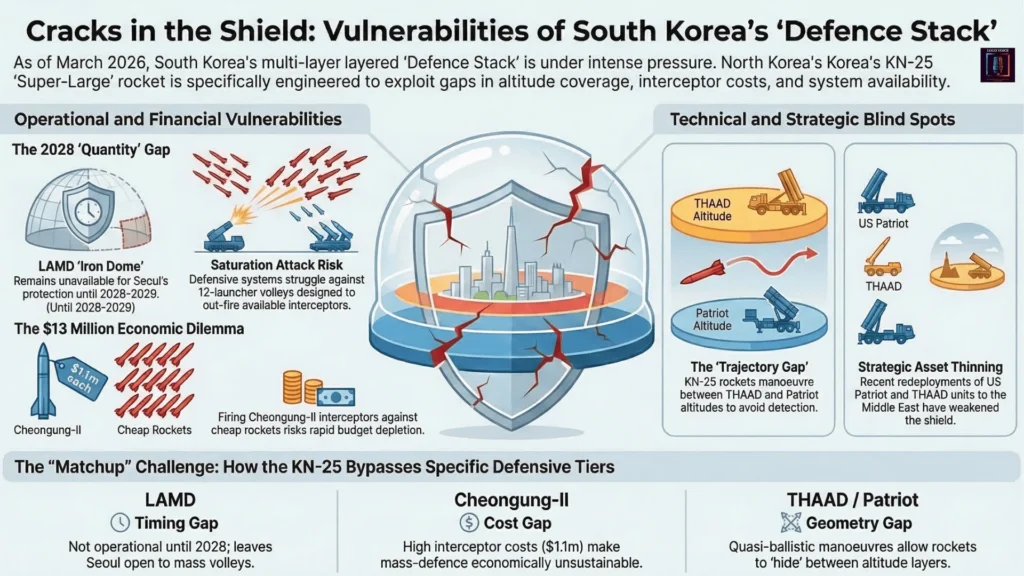
| Defensive System | Role | Current Status / Challenge |
| LAMD (Korean Iron Dome) | Point-defense against low-altitude artillery/rockets. | Development Gap: Aimed at stopping massed barrages,but not expected to be fully operational until 2028–2029. Seoul currently has no high-volume equivalent to counter the KN-25 salvo. |
| Cheongung-II (M-SAM) | Medium-altitude ballistic/cruise missile defense (upto 40 km). | Economic/Quantity Gap: An excellent, combat-proven system (recently used successfully by the UAE), but very expensive. It is not designed to intercept numerous “cheap” rockets; using million-dollar interceptors to stop a 12-rocket volley is an asymmetric disadvantage for the defender. |
| Patriot (PAC-3) / THAAD | High-altitude/terminal-phase ballistic defense. | Vulnerability Gap: These are the primary shields against SRBMs. However, their effectiveness is degraded by the KN-25’s quasi-ballistic trajectory. |
The U.S. Asset Realignment (March 2026):
The dynamic changed significantly in early March 2026 with the sudden redeployment of U.S. Patriot (PAC-3) and THAAD assets from South Korea to the Middle East.
- Patriot Redeployment: The movement of Patriot batteries away from key sites like Osan Air Base leaves high-value targets—such as South Korea’s own F-35A fleet and Hyunmoo missile launchers—more vulnerable to the exact type of saturation strike North Korea just demonstrated.
- THAAD Gap: The most critical movement was the relocation of key THAAD components. THAAD is the only system on the peninsula capable of high-altitude interception (40–150 km). Its removal creates a clear “blind spot” for upper-tier defense against the KN-25.
The Impact on South Korea’s “Kill Chain”
This defensive vacuum directly compromises the “Kill Chain”, which is the first pillar of South Korea’s Three-Axis system. The Kill Chain is a preemptive strike strategy designed to destroy North Korean missile and nuclear launch capabilities before they can fire. It relies on a high-speed “detect, decide, and strike” loop of under 30 minutes.
How the Defensive Void Undermines Preemption:
- A Vulnerable Shield: The Kill Chain requires South Korea’s own offensive strike platforms to be secure. The reduction of Patriot protection means the very assets needed for a preemptive strike (F-35As, missile launchers) are now more vulnerable to a North Korean counter-strike or a surprise preemptive rocket salvo.
- A “Quality” Bottleneck: Without THAAD and Patriot protection, the reliance on Cheongung-II increases exponentially. However, Cheongung-II is excellent at stopping high-end ballistic threats, not mass-fire artillery. A massive North Korean saturation attack, which the KN-25 is built for, could rapidly deplete South Korea’s inventory of advanced interceptors, forcing a “reset” of the defensive line during a crisis.
The Way Forward – Korea’s Accelerating Arms Race
The combined effect of North Korea’s tactical nuclear rocket test and the retreat of U.S. defensive assets is forcing South Korea to take “primary responsibility” for its own peninsula-focused deterrence. This shift, a fundamental part of the U.S. policy of “Strategic Flexibility,” is accelerating South Korea’s development of indigenous alternatives.
All eyes are now on South Korea’s L-SAM Block II system. This domestic upper-tier interceptor, designed to replace the capabilities of THAAD and Patriot with an intercept altitude of up to 100 km, has been rushed from development into mass production. However, it will take years to reach full operational capability.
Conclusion & FAQs
The March 14, 2026, rocket test was a sophisticated display of “coercive diplomacy.” Kim Jong Un validated the technical maturity of a “deadly” saturation strike system designed to neutralize South Korea’s qualitative edge with overwhelming quantity. His daughter’s presence normalized this nuclear future.
Simultaneously, the movement of U.S. defenses to the Middle East exposed South Korea’s dangerous dependence on “quality over quantity” and severely weakened the preemptive Kill Chain strategy. The test was not merely a military exercise; it was a demonstration that North Korea understands this newfound defensive gap and is prepared to exploit it.
Frequently Asked Questions (FAQs)
What is the North Korean KN-25 rocket launcher?
The KN-25 is a 600mm multiple rocket launcher (MRL) capable of firing tactical nuclear warheads and utilizing guidance systems for precision strikes.
Why is Kim Jong Un’s daughter at missile launches?
Analysts believe it is part of a “grooming” process to position her as her father’s successor and to “normalize” North Korea’s identity as a permanent nuclear state for the next generation.
Is South Korea’s Iron Dome (LAMD) ready?
South Korea’s Low-Altitude Missile Defense (LAMD) system, its answer to massed rocket barrages, is in active development but not expected to be fully operational until 2028–2029.
How does the U.S. defense shift affect South Korea?
The removal of Patriot and THAAD assets creates a “blind spot” in South Korea’s high-altitude defense and weakens the protection of high-value targets, forcing Seoul to accelerate its own indigenous defense systems.
