

Introduction: The Perilous River of Desire
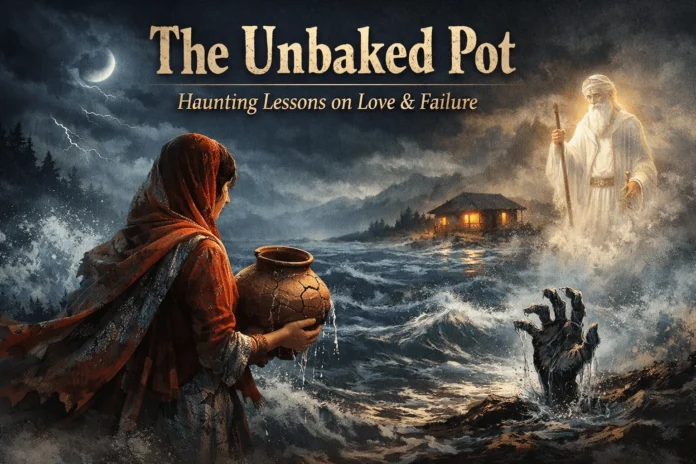
The Unbaked Pot is a powerful symbol of a longing we all recognize—the kind of desire so intense that it clouds judgment and silences reason. When something feels just within reach, we often ignore clear dangers, brush aside rational warnings, and press forward despite impossible odds. This enduring tension between passion and prudence lies at the core of a timeless Pakistani folk ballad, carried to a global audience through Coke Studio’s haunting rendition of “Paar Chanaa De.”
The song tells the story of a young woman determined to cross a treacherous river at night to meet her beloved, her only aid a simple clay pot. But to be seduced by the melody alone is to miss the ballad’s brutal genius. The song is not a lullaby; it is a surgical dissection of self-destruction, built around a tense dialogue between the girl and her vessel. Personifying the clay pot is a stroke of narrative genius; it externalizes her internal conflict, transforming a solitary, internal struggle into a dramatic, life-or-death debate. Beneath its beautiful surface, the song’s poetic lyrics offer profound lessons about the clash between passion and reality.
Passion Argues with Reality
The song is structured not as a simple narrative, but as an escalating negotiation between two opposing forces. The girl’s focus is absolute, her vision locked on the goal: “Right there across the Chenab river lies my beloved’s hut,” she sings, urging her vessel onward with a desperate plea, “Come on, clay-pot, let’s keep going.”
But the pot is the voice of objective truth, an active, reasoning conscience. It counters her emotional drive not with silent resistance, but with a grim assessment of the situation: “The night is deathly dark, the river waves surge high around us.” This is more than a warning; it is a desperate plea to abandon a fatal course. “Oh listen, girl, don’t be stubborn,” the pot begs, using the intimate Punjabi phrase, aṛiye aṛiye haan ni aṛiye. It isn’t revealing a secret; it’s stating a common-sense principle that passion often makes us forget, adding that its warning, “eh gal ‘aam ni,” is “a truth known to all.”
The exchange reflects a struggle familiar to all of us—the impulse of the heart that urges action, set against the caution of reason that recognizes imminent risk. Like a vessel shaped from raw, unfired clay, I am fragile by nature, destined to dissolve in flowing water. Lacking firmness and stability, I am doomed to falter before the journey can ever be completed.
The ‘Unbaked Pot’ Is a Metaphor for Any Flawed Plan
The “kacchi miṭṭi” (unbaked clay) is the central metaphor of the ballad, symbolizing any weak foundation upon which we place our hopes. It’s the startup founder ignoring a fatal market flaw because they’ve fallen in love with their product. It’s the individual staying with a partner whose core values are incompatible with their own, hoping sheer will can bridge the gap. It is any crucial, faulty component in a plan destined to fail.
The pot itself understands this universal principle, stating plainly, “The unsound can only reach an unsound end.” This is a fundamental law of cause and effect. The song serves as a powerful cautionary tale about the critical importance of assessing our tools and supports before embarking on a perilous journey. Relying on something inherently flawed is not a test of faith; it is an invitation for disaster.
Don’t rely on the unsound to help you reach the shore.
Willpower Is Not Enough
In a world filled with stories of underdogs overcoming impossible odds, this folk tale offers a much darker and, perhaps, more realistic lesson. The protagonist’s fierce determination does not conquer the physical reality of the storm or the structural weakness of the pot. Just before the tragic end, we witness the final flicker of her hope against the encroaching darkness. As the waves swell, she tries to rally her own spirits with a moment of self-delusion: “Look, the waves are splashing higher and higher, but don’t lose heart.”
This makes the story’s unflinching turn towards tragedy all the more powerful. Instead of finding a miraculous way to succeed, the girl accepts her fate, foreseeing her own death with chilling clarity. This is the ballad’s most haunting lesson: passion and resolve, while essential, cannot always bend the laws of physics. Certain barriers cannot be overcome by courage alone; to dismiss them is not an act of bravery but an invitation to destruction. By nightfall, love itself will be forced to confront death, as the one who waits in hope is met only by the lifeless form of the one he cherishes.
The Final Wisdom: From Flawed Vessel to Sound Guide
After painting a bleak picture of inevitable failure, the song offers a final, crucial piece of wisdom. It presents an alternative to the fragile “kaccha ghara” (unbaked pot): the “pakke murshad,” or the “sound guide.”
In the Sufi tradition from which this imagery is drawn, a murshad is a spiritual teacher or guide—a source of earned wisdom. The ballad elevates this concept into a universal message. While relying on the flawed and the “unbaked” leads to disaster, the path to safety lies in finding and holding onto something—or someone—strong, reliable, and true. This “sound guide” could be a trusted mentor, a well-researched plan, or a set of unwavering principles. It represents the strength and certainty the unfired vessel could never possess. Place your trust in the steady guide whose firmness alone can carry you securely across to the far shore.
Conclusion: What Is Your Clay Pot?
“Paar Chanaa De” is more than a tragic love story; it is a timeless allegory about the foundations we build our hopes upon. It forces us to look beyond our burning desires and critically examine the tools we are using to achieve them. The girl had overwhelming passion and desperate hope, but the river demanded a sound vessel. The universe does not grade on effort alone; it judges the integrity of our foundations.
In our own desperate pursuits, as we gaze across the river at our goals, it is the most important question we can ask ourselves: What are the ‘unbaked pots’ we are relying on, and where can we find our ‘sound guide’?
