

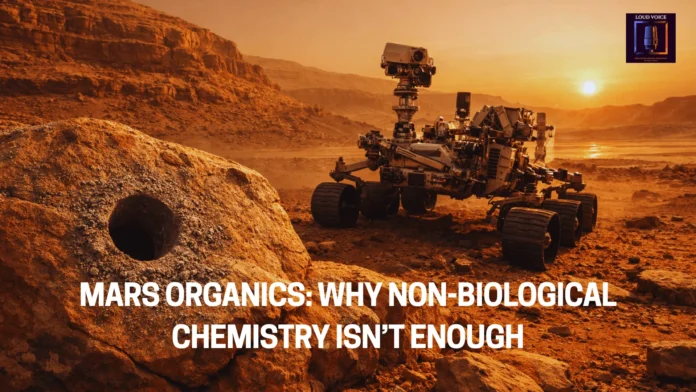
Mars Organics That Chemistry Alone Can’t Explain
Mars just became a lot more interesting. A new NASA-led study of a rock drilled by the Curiosity rover in Gale Crater concludes that known non-biological processes cannot fully account for the organic molecules locked inside it. The result doesn’t prove past life on Mars—but it makes that possibility scientifically reasonable to consider in a way it hasn’t been before.
The Rock That Changed the Conversation
The story centers on a drill hole called Cumberland, made in 2013 in a mudstone at Yellowknife Bay, near the base of Gale Crater’s ancient sedimentary stack. Geological evidence suggests this region was once part of a long-lived lake about 3.7 billion years ago, with clay minerals, sulfur-bearing compounds, and nitrates that together point to a stable, potentially habitable environment.
Curiosity’s instruments had already shown that Gale Crater once hosted water that was neither too acidic nor too salty, and that the rocks contained many of the chemical ingredients needed for life. What Cumberland adds to this picture is something more specific: a population of relatively large organic molecules, including long-chain hydrocarbons that, on Earth, are often linked to biological processes.
These compounds are preserved in fine-grained mudstone, a rock type well known on Earth for its ability to “archive” organic material in lake and seabed sediments. That makes Cumberland an ideal test case for asking a very big question with a very small sample: could some of Mars’s organic chemistry be biological in origin?
What Curiosity Actually Found
Curiosity’s on-board Sample Analysis at Mars (SAM) laboratory works by heating powdered rock samples and analyzing the gases that are released. In the Cumberland sample, SAM detected three key organic molecules: decane, undecane, and dodecane, all members of a class of hydrocarbons called alkanes.
These compounds:
- Contain 10, 11, and 12 carbon atoms respectively.
- Are larger than most organics previously detected on Mars’s surface.
- Are consistent with being fragments of even larger organic molecules, such as fatty acids embedded in the rock.
On Earth, organic molecules of this size and type frequently arise when long-chain fatty acids—major components of cell membranes—are broken down by heat or radiation over geological time. They are not, by themselves, proof of life, because non-living processes can also produce alkanes, but they immediately raised the question: are there known non-biological ways to make enough of these molecules in Gale Crater to match what Curiosity observed?
The new study is an attempt to answer exactly that.
Rewinding 80 Million Years of Martian History
One complication in interpreting organics on Mars is that the planet’s surface is harsh. High-energy cosmic rays, solar radiation, and oxidizing chemicals steadily destroy organic molecules near the top layers of rock. Cumberland has been exposed at the surface for roughly 80 million years—a long time for radiation to do its work.
To get around this, the research team used a three-pronged strategy:
- Laboratory radiation experiments: They exposed Earth rocks and organics to radiation in conditions that mimic Mars, measuring how fast different molecules break down.
- Mathematical modeling: They built models of how cosmic rays penetrate and damage the Cumberland rock over tens of millions of years, essentially “running the clock backwards” to estimate how much organic material was present when the rock was first exposed.
- Curiosity data: They combined these models with Curiosity’s actual SAM measurements of decane, undecane, and dodecane abundances in the sample.
When they reconstructed the original concentration of organics before 80 million years of radiation damage, the numbers were striking: the inferred starting abundance of these long-chain molecules was far higher than what standard non-biological processes are expected to produce in such a rock.
That discrepancy is the heart of the new result.
Testing Non-Biological Explanations
The team systematically evaluated known non-biological sources that might have supplied these organics to Gale Crater.
1. Carbonaceous Meteorites
One of the biggest “delivery systems” for organic molecules to any rocky planet is carbon-rich meteorites. These objects are known to contain a wide suite of organics, including simple fatty acids and related compounds formed in interstellar space and the early solar system.
The researchers asked: if Cumberland’s organics came purely from such meteorites, how much material would need to fall into Gale Crater, and how much would be preserved in the rock after billions of years and 80 million years of surface exposure?
Their conclusion: even under generous assumptions, meteorites alone could not supply enough of the specific long-chain molecules inferred in the sample. The modeled concentrations consistently fell short of the reconstructed original abundance.
2. Geological and Hydrothermal Processes
Another possibility is that Mars itself might generate such organics through purely chemical processes—say, in hydrothermal systems or through reactions between water, rock, and volcanic gases.
These processes can indeed create organic molecules, especially shorter chains, and may have operated on ancient Mars as they do in some environments on Earth. But when the team compared known abiotic pathways and their expected yields with the modeled starting concentrations in Cumberland, they again found a mismatch.
Shorter-chain molecules and lower concentrations look compatible with geological chemistry; the inferred high abundance of larger organics does not.
3. Unknown Chemistry?
The authors are careful to note that our understanding of Martian chemistry is incomplete. There could be non-biological alkane formation pathways under Martian conditions that have not yet been identified or replicated in the lab. There might also be complexities in radiation processing or mineral-organic interactions that alter survival rates in ways current models do not capture.
For now, however, when they plug in all the non-biological sources and processes they do know about, the total still does not reach the level needed to explain the reconstructed organic inventory in Cumberland.
Why Scientists Are Now Talking About Life—Carefully
The Astrobiology paper offers a carefully framed takeaway: because the non-biological mechanisms they evaluated still fall short of producing the observed level of organic molecules, the authors argue that a biological origin is now a legitimate hypothesis to test—and that choice of wording is deliberately restrained.
The study does not claim that life has been discovered on Mars. It does not claim that no non-biological explanation is possible. Instead, it says:
- Given current knowledge, abiotic sources underperform.
- A biological source is now a scientifically valid working hypothesis.
- More data and more experiments are needed to discriminate between biology and unknown chemistry.
In other words, this is not a “smoking gun,” but it is a compelling clue that pushes Mars further into the category of a world whose rocks may record more than just sterile chemistry.
What This Means for Gale Crater
For Gale Crater, the implications are significant. We already knew from Curiosity’s decade-plus of work that:
- Ancient Gale hosted persistent liquid water in lakes and streams.
- The chemistry of its rocks includes clay minerals, sulfates, nitrates, and other compounds compatible with habitable conditions.
- It has preserved organic molecules of various sizes in multiple sedimentary layers.
The new study adds a crucial layer: the quantity and character of some of these organics are difficult to explain without considering life as one possible source.
That elevates Gale from “once habitable” to “potential repository of subtle biosignatures,” at least in terms of working hypotheses. It also validates the original mission gamble: choosing a sedimentary crater with a deep stratigraphic record was the right strategy if you want to chase ancient organics on Mars.
Why We Still Need Sample Return
No matter how powerful Curiosity’s instruments are, they are still limited compared to Earth-based laboratories. To truly test whether Gale’s organics are biological, scientists would like to perform:
- High-precision isotopic measurements (for example, checking carbon and hydrogen isotope ratios that can distinguish biological from abiotic sources).
- Detailed molecular analyses of complex mixtures, including chirality (left- vs right-handedness) of potential biomolecules.
- Experiments that can search for subtle degradation products that Curiosity’s SAM is not designed to detect.
At present, there is no mission specifically tasked with returning samples from Gale Crater, and NASA’s evolving Mars Sample Return architecture focuses on cores collected by the Perseverance rover in Jezero Crater. However, the Cumberland results strengthen the case—scientifically and politically—for future missions that can either:
- Access deeper, better-shielded sediments within Gale, or
- Return Gale-like materials to Earth, whether from Gale itself or analogous environments elsewhere on Mars.
Until then, Curiosity remains our only in situ laboratory for this site, and it will continue probing new layers and rock types to see whether the organic signal in Cumberland is an isolated curiosity or part of a broader pattern.
Open Questions and Next Steps
The new study opens as many questions as it answers, which is often the mark of a genuinely important result.
Some of the most pressing questions include:
- How typical is Cumberland?
Are similar organics found in other mudstones and stratigraphic levels in Gale, or is this particular rock unusually enriched? - What exactly is the original molecule?
Decane, undecane, and dodecane look like breakdown products, but what was the parent compound—fatty acids, other lipids, or something completely different? - How robust are the radiation models?
Better lab simulations of organics embedded in various Mars-like minerals, under realistic temperature and radiation conditions, could refine estimates of survival times and initial concentrations. - What unknown abiotic pathways are we missing?
Identifying new non-biological routes to long-chain organics under Martian conditions would help clarify whether life is truly needed to explain what Curiosity sees.
Laboratory experiments on Earth, combined with ongoing observations from Curiosity and other Mars missions, will gradually narrow the range of possibilities. For now, the study’s main contribution is conceptual: it moves the discussion of Martian organics from “they exist, but probably from non-living chemistry” toward “they exist, and some of them are hard to explain without at least considering life.”
Why This Matters Beyond Mars
Whether or not these particular molecules ultimately turn out to be biological in origin, the methods developed in this study have wide-reaching implications.
By combining:
- In situ rover measurements
- Controlled radiation experiments
- Detailed physical and chemical modeling
scientists are building a toolkit for interpreting organic signatures on other worlds as well, from the icy moons of Jupiter and Saturn to future samples from asteroids and comets.
If nothing else, the Cumberland rock is teaching us how to read an astrobiological record written under harsh conditions over billions of years. Even a null result—if future work finds an entirely non-biological explanation—would still refine how we search for life elsewhere.
For now, though, Mars has offered us a tantalizing hint: in at least one small patch of ancient lakebed, the chemistry looks richer than simple geology can comfortably explain.
