

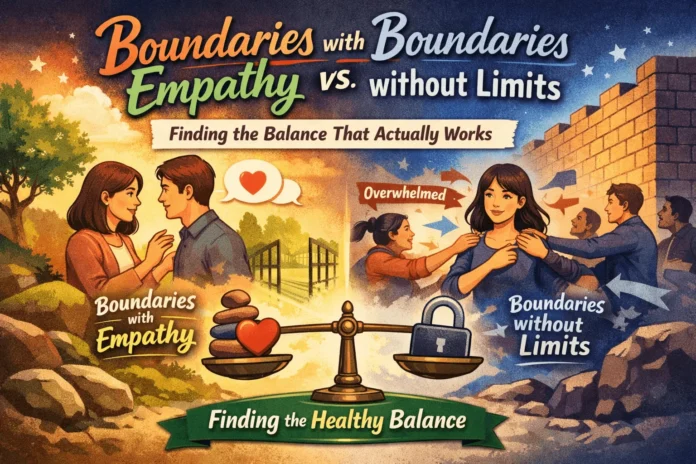
Setting boundaries is one of those things everyone says you should do, but almost no one explains how to do well. The internet is full of advice that swings wildly between two extremes: either you’re told to set rigid boundaries that make you sound like a corporate email template, or you’re encouraged to be so understanding that your boundaries dissolve entirely.
Neither extreme work in real relationships. What does work is something I call boundaries with empathy—a middle path that protects your wellbeing while maintaining genuine connection with others.
What Boundaries with Empathy Actually Look Like
Boundaries with empathy operate from a simple premise: you can care about someone’s feelings while still protecting your own needs. These aren’t contradictory goals.
When you set a boundary with empathy, you acknowledge the other person’s reality while being clear about your own limitations. You might say to a friend who frequently calls during your work hours: “I know you’re going through a really difficult time right now, and I want to be there for you. I can’t take calls during my workday, but I’m free after 6 PM and would love to talk then.”
Notice what’s happening here. You’re not dismissing their struggle. You’re not pretending your boundary doesn’t affect them. You’re simply being honest about what you can sustainably offer.
The key characteristics of boundaries with empathy include:
Honesty about your capacity. You don’t pretend you have infinite resources. You acknowledge your actual bandwidth—whether that’s emotional, physical, temporal, or financial.
Recognition of impact. You understand that your boundary might disappoint or inconvenience the other person, and you don’t gaslight them about that reality. Disappointment is allowed to exist.
Consistency without cruelty. You maintain your boundaries steadily, but you don’t weaponize them or deliver them with unnecessary harshness.
Openness to dialogue. While you’re firm about your limits, you’re willing to have conversations about them, explain your reasoning, and sometimes negotiate the details.
Self-awareness about motivation. You’ve examined whether your boundary serves a genuine need or whether it’s motivated by avoidance, punishment, or fear.
The Problem with Boundaries without Limits
“Boundaries without limits” sounds paradoxical, but I’m referring to boundaries that are either so rigid they lack any flexibility, or so poorly defined that they’re essentially non-existent.
On one end, you have what I call fortress boundaries. These are people who’ve learned that boundaries are important and have overcorrected by treating every request, every emotional need from others, as an intrusion. They respond to normal human interdependence with walls so high that genuine intimacy becomes impossible.
A parent might say to their adult child: “I don’t discuss anything related to emotions. Saying “that’s what therapists are for” may protect personal space, and emotional boundaries within families are absolutely legitimate. But when emotional openness is entirely off-limits, the relationship risks shrinking into something functional and distant—more about roles than real connection.
On the other end are dissolved boundaries—what happens when empathy completely overtakes self-protection. This shows up as chronic overgiving, difficulty saying no, and a tendency to absorb others’ problems as your own. You might find yourself regularly sacrificing sleep to help others, spending money you don’t have, or betraying your own values to keep the peace.
Both extremes share a common thread: they’re fear-based. Fortress boundaries come from fear of being hurt, manipulated, or overwhelmed. Dissolved boundaries come from fear of abandonment, conflict, or being seen as selfish.
Neither approach is sustainable. Fortress boundaries lead to isolation and shallow relationships. Dissolved boundaries lead to resentment, burnout, and relationships built on inequality.
Why Empathy Makes Boundaries Stronger, Not Weaker
There’s a widespread misunderstanding that adding empathy to boundaries somehow weakens them—that if you acknowledge someone’s feelings, you’re opening the door to negotiation or manipulation.
The opposite is true. Empathy makes boundaries more effective because it removes the need for defensiveness.
When you set a boundary defensively—with justifications, apologies, or aggression—you signal that your boundary is up for debate. You’re essentially saying, “Here’s my boundary, but let me convince you why it’s valid.” This invites pushback.
When you set a boundary with empathy, you’re simply stating a fact about your capacity while acknowledging reality for the other person. There’s nothing to argue with because you’re not claiming the boundary doesn’t affect them or that they shouldn’t feel disappointed.
Consider these two approaches to the same situation:
Without empathy: “I’m not lending you money anymore. You never pay me back and I’m done being your bank.”
With empathy: “I care about you and I know you’re in a difficult financial situation. I’m not able to lend money right now—it’s created strain for me in the past and I need to protect that boundary. I’m happy to help you brainstorm other options if that would be useful.”
The second response is actually firmer because it’s clearer, calmer, and less reactive. It doesn’t invite argument or create unnecessary conflict. The person may still be disappointed, but they’re less likely to feel attacked or become defensive themselves.
Common Situations Where This Balance Matters
The chronically late friend. Boundaries with empathy: “I know you have a hard time with punctuality, and I’m not judging that. What I need going forward is to only plan activities where timing isn’t crucial, or to proceed with plans at the agreed time even if you’re running late. I value our friendship and I also need to protect my time.”

The parent who doesn’t respect your parenting choices. Boundaries with empathy: “I know you raised us differently and your methods worked for you. I appreciate that you want to help. I need you to follow our rules about screen time when you’re watching the kids. If that’s not something you’re comfortable with, I understand, and we can find other ways for you to spend time with them.”
The colleague who constantly asks for help. Boundaries with empathy: “I can see you’re overwhelmed with this project. I have my own deadlines that I need to prioritize. I can spend 15 minutes showing you where to find the resources you need, but I can’t take on additional work right now.”
The friend going through crisis after crisis. Boundaries with empathy: “I care about what you’re going through, and I’ve noticed that our conversations have been really heavy for the past few months. I’m realizing I don’t have the emotional capacity to be your primary support person right now. I think talking to a therapist could give you more consistent help than I can offer. I still want to spend time together—maybe we could do something lighter this week, like catching a movie?”
The Skills That Make Empathetic Boundaries Possible
Setting boundaries with empathy isn’t just about what you say—it’s a skill set that requires development.
Emotional regulation. You need to be able to tolerate someone else’s disappointment without either caving to make it stop or becoming defensive and hostile. This means managing your own anxiety when someone is upset with you.
Clear self-knowledge. You have to know what your actual limits are, which requires paying attention to your body, your emotions, and your patterns. Many people don’t know they’re at their limit until they’ve crashed past it.
Distinguishing between guilt and appropriate responsibility. Guilt can be a useful signal that you’ve violated your values, but it’s often triggered by simply disappointing someone. Learning to sit with the discomfort of someone being unhappy with your choice—without that meaning you’ve done something wrong—is essential.
Communication skills. This includes being direct rather than hinting, using “I” statements, avoiding blame language, and being specific about what you need rather than what the other person shouldn’t do.
Tolerance for conflict. Boundaries sometimes create tension. People who avoid conflict at all costs will struggle to maintain boundaries because they’ll sacrifice the boundary to restore harmony.
When Empathy Shouldn’t Be Part of the Equation
Importantly, boundaries with empathy are appropriate for relationships with generally well-intentioned people who are capable of respecting your limits. They’re not designed for every situation.
If someone is abusive, manipulative, or consistently violates your boundaries, empathy in your boundary-setting can actually be counterproductive. In those cases, you may need to be more direct, offer less explanation, and potentially exit the relationship entirely.
You’re not required to extend emotional consideration to strangers or loose acquaintances who make unreasonable requests. In those moments, a straightforward “That doesn’t work for me” is more than enough.
The empathy component is most valuable in relationships you want to maintain—with family, close friends, partners, and colleagues you’ll continue working with. It’s about preserving connection while still protecting yourself.
Building Your Boundary-Setting Practice
If you’re someone who struggles with boundaries, start small. Pick one area where you consistently overextend and practice setting a simple limit. Notice what happens in your body when you do this. Many people feel intense anxiety, guilt, or fear. These feelings are information, not instructions.
Pay attention to the stories you tell yourself about boundaries. Do you believe that setting limits makes you selfish? That people will abandon you if you’re not always available? That your needs matter less than others’? These underlying beliefs will sabotage your boundaries until you address them.
Practice the language of empathetic boundaries in low-stakes situations first. Experiment with phrases like “I understand where you’re coming from, and what works for me is…” or “I appreciate you thinking of me for this, and I’m not available.”
Watch for the pattern of over-explaining. When you find yourself giving three paragraphs of justification for a simple “no,” that’s a sign you don’t fully believe you’re entitled to your boundary. You are. You don’t need an airtight case to defend your own limits.
The Long-Term Payoff
Relationships built on boundaries with empathy are more honest, more sustainable, and ultimately more intimate than relationships that lack clear limits. When people know where they stand with you, when your “yes” means yes and your “no” means no, trust deepens.
You demonstrate something powerful—that compassion and limits don’t cancel each other out. By holding both, you quietly show others that they’re allowed to protect themselves without abandoning kindness.
The goal isn’t perfect boundaries. You’ll sometimes cave when you wish you hadn’t. You’ll sometimes be too rigid when flexibility would have served the relationship. What matters is the overall pattern—a commitment to honoring both your own needs and your care for others, understanding that in healthy relationships, these don’t have to be at odds.
