

Introduction: Understanding Trump Venezuela Policy in Context
Trump Venezuela policy marked one of the most aggressive U.S. approaches toward Latin America in recent decades. From the outset, the administration of Donald Trump framed Venezuela not merely as a humanitarian crisis but as a strategic challenge involving authoritarianism, socialism, and geopolitical rivals such as Russia, China, and Iran.
Unlike earlier administrations that relied on diplomacy and limited sanctions, Trump Venezuela policy adopted a strategy of maximum pressure. This approach combined economic sanctions, diplomatic isolation, financial controls, and symbolic recognition of an alternative government. The policy was designed to weaken the regime of Nicolás Maduro, force political transition, and signal a hardline U.S. stance against left-wing authoritarian regimes in the Western Hemisphere.
The Strategic Foundations of Trump Venezuela Policy
Trump Venezuela policy did not emerge in isolation. By 2017, Venezuela was experiencing hyperinflation, institutional breakdown, mass migration, and international condemnation. The Trump administration interpreted this collapse as both a humanitarian disaster and a geopolitical opening. At its core, Trump Venezuela policy rested on three assumptions:
- Venezuela’s economy was uniquely vulnerable due to its dependence on oil revenue.
- International legitimacy mattered to the Maduro government.
- Coordinated economic pressure could fracture elite support for Maduro.
These assumptions shaped the administration’s belief that sanctions—if broad and aggressive enough—could force regime change without direct military intervention.
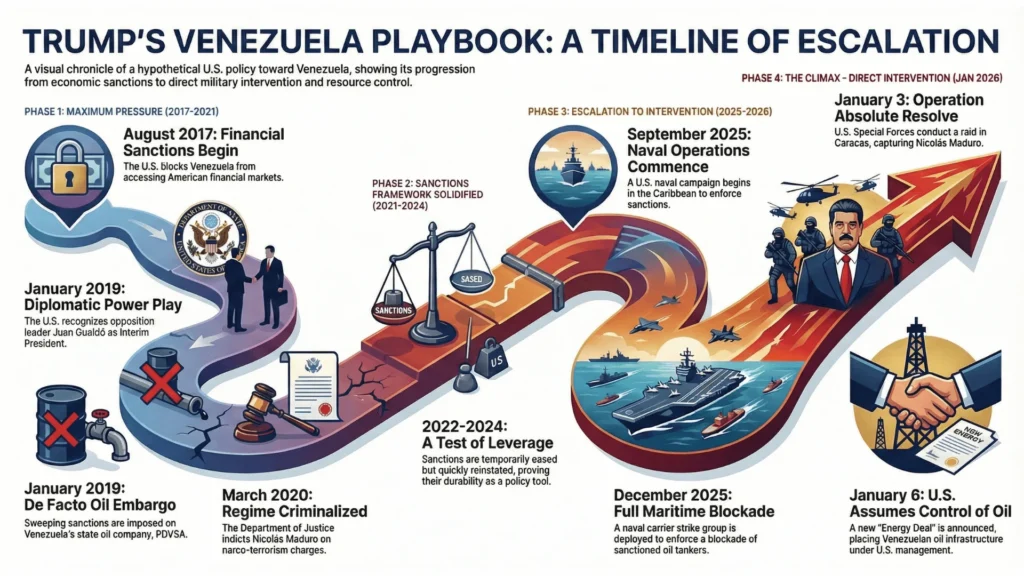
Chronological Timeline of Trump Venezuela Policy (2017–2026)
Phase I: First Trump Administration and the “Maximum Pressure” Doctrine (2017–2021)
The initial phase of Trump Venezuela policy was defined by economic coercion and diplomatic isolation. The objective was to delegitimize the government of Nicolás Maduro, fracture elite loyalty, and force a negotiated democratic transition without direct military involvement.
August 2017 – Financial Sanctions Initiated
President Donald Trump signed Executive Order 13808, restricting the Venezuelan government and PDVSA from accessing U.S. financial markets.
Analytical relevance: This marked the shift from symbolic condemnation to structural economic containment, limiting Venezuela’s ability to refinance debt or stabilize its economy.
May 2018 – Sanctions After Disputed Elections
Following Venezuela’s widely contested presidential election, the U.S. expanded sanctions to prohibit transactions involving Venezuelan sovereign debt.
Analytical relevance: The move signaled that electoral legitimacy had become a central condition for economic engagement.
January 2019 – Diplomatic Recognition of the Opposition
The U.S. formally recognized Juan Guaidó, then President of the National Assembly, as Venezuela’s Interim President.
Analytical relevance: This was a decisive attempt to transfer international legitimacy away from Maduro without changing power realities on the ground.
January 28, 2019 – De Facto Oil Embargo
The Trump administration imposed sweeping sanctions on PDVSA, freezing assets under U.S. jurisdiction and barring transactions with the company.
Analytical relevance: Oil sanctions became the backbone of Trump Venezuela policy, targeting the regime’s primary revenue source.
March 2020 – Criminalization of the Regime
The U.S. Department of Justice indicted Maduro and senior officials on narco-terrorism and drug trafficking charges, offering a $15 million reward for information leading to his arrest.
Analytical relevance: This reframed the Venezuelan crisis from a political dispute into a transnational criminal case.
August 2020 – Enforcement Beyond Venezuela
U.S. authorities seized four Iranian fuel tankers en route to Venezuela, enforcing sanctions across international shipping lanes.
Analytical relevance: Trump Venezuela policy expanded into extraterritorial enforcement, signaling global reach and raising geopolitical tensions.
Phase II: Interim Adjustment under the Biden Administration (2021–2024)
Although outside Trump’s direct control, this period is essential for analytical continuity, as it demonstrates the durability of the sanctions framework he created.
2022–2023 – Limited Sanctions Relief
The Biden administration granted Chevron a license to resume limited oil operations in Venezuela. In October 2023, broader oil sanctions were temporarily eased following the Barbados Agreement.
Analytical relevance: This phase tested whether partial economic relief could incentivize political concessions.
April 2024 – Sanctions Reimposed
Sanctions were reinstated after Maduro barred opposition candidates from elections.
Analytical relevance: The reimposition confirmed that Trump-era sanctions had become a bipartisan leverage tool rather than a temporary policy experiment.
Phase III: Second Trump Administration and Escalation (2025–2026)
Upon returning to office, Trump Venezuela policy transitioned from economic coercion to direct intervention, reflecting a belief that sanctions alone had reached their strategic limit.
January 2025 – Rejection of Maduro’s Third Term
Trump rejected Maduro’s inauguration and revoked Temporary Protected Status (TPS) for approximately 600,000 Venezuelans in the U.S.
Analytical relevance: This linked immigration policy directly to foreign pressure strategy.
February 2025 – Terrorism Designation
The Tren de Aragua criminal network was designated a foreign terrorist organization, with U.S. officials alleging ties to the Maduro government.
Analytical relevance: This provided a legal framework for expanded security operations.
August 8, 2025 – Escalation of Criminal Pressure
The U.S. doubled the reward for Maduro’s arrest to $50 million, labeling him a “global terrorist leader.”
Analytical relevance: The strategy shifted from isolation to active pursuit.
September 2025 – Maritime Operations Begin
A naval “anti-narcotics” campaign commenced in the Caribbean, targeting vessels allegedly linked to Venezuelan drug trafficking.
Analytical relevance: Military presence became a visible component of Trump Venezuela policy.
October 15, 2025 – Covert Operations Authorized
Trump authorized the CIA to conduct covert actions aimed at destabilizing the so-called “Cartel de los Soles.”
Analytical relevance: This marked the transition from overt pressure to clandestine intervention.
December 2025 – Full Maritime Blockade
A sweeping maritime enforcement regime was instituted, halting all sanctioned oil tanker movements, while the USS Gerald R. Ford carrier strike group was forward-deployed to the Caribbean to underpin the blockade with military deterrence.
Analytical relevance: This represented the militarization of economic sanctions.
January 2026 – Direct Intervention and Control Phase
January 3, 2026 – Operation Absolute Resolve
U.S. Special Forces conducted a raid in Caracas, capturing Nicolás Maduro and Cilia Flores, who were transferred to the United States.
Analytical relevance: This was the culmination of Trump Venezuela policy—direct regime removal through force.
January 5, 2026 – Legal and Political Fallout
Appearing before a federal court in Manhattan, Nicolás Maduro entered a plea of not guilty, while in Caracas Delcy Rodríguez assumed the role of Acting President, condemning the operation as an act of illegal intervention.
Analytical relevance: The crisis shifted from sanctions enforcement to transitional governance.
January 6, 2026 – U.S. Energy Control Announcement
Trump unveiled a new “Energy Deal,” stating that U.S. companies would manage Venezuelan oil infrastructure and control proceeds from 30–50 million barrels of sanctioned oil.
Analytical relevance: Economic leverage evolved into direct resource management.
January 8, 2026 – Clarification of U.S. Intent
Marco Rubio emphasized that Washington had no intention of sustaining a permanent presence, while making clear that the United States would retain decisive influence over Venezuela’s energy assets and external alignments.
Analytical relevance: This positioned Trump Venezuela policy as a hybrid model of intervention, economic control, and strategic disengagement.
Sanctions as the Central Instrument of Trump Venezuela Policy
The most visible pillar of Trump Venezuela policy was the expansion of sanctions. Beginning in 2017, the U.S. issued executive orders restricting Venezuela’s access to American financial markets. These measures escalated significantly after 2019.
The turning point came with sanctions on PDVSA, Venezuela’s state-owned oil company. Oil exports accounted for over 90% of Venezuela’s foreign currency earnings, making the sector an obvious target. By freezing U.S.-based assets and restricting oil transactions, Trump Venezuela policy aimed to cut off the Maduro government’s financial lifeline.
Sanctions were also personalized. Senior officials, military leaders, judges, and alleged intermediaries were blacklisted by the U.S. Treasury’s Office of Foreign Assets Control. This tactic sought to increase elite defection by raising the personal costs of loyalty to Maduro.
From an analytical perspective, Trump Venezuela policy used sanctions not as symbolic punishment but as an economic weapon intended to restructure political incentives inside Venezuela.
Oil, Energy, and the Geoeconomic Logic
Energy policy sat at the heart of Trump Venezuela policy. Venezuela possesses the world’s largest proven oil reserves, making its energy sector strategically significant beyond domestic politics.
By targeting oil production, shipping, and refining, Trump Venezuela policy sought to isolate Venezuela from global energy markets. Sanctions extended to shipping networks, intermediaries, and financial institutions accused of facilitating oil-for-cash or oil-for-goods arrangements.
From a geoeconomic standpoint, the policy aimed to deny Maduro access to revenue while also discouraging rival powers from filling the vacuum. However, this also accelerated Venezuela’s turn toward non-Western partners and informal trade networks, partially offsetting U.S. pressure.
Humanitarian Impact and Ethical Debate
One of the most controversial aspects of Trump Venezuela policy concerns its humanitarian consequences. Critics argue that broad oil sanctions worsened shortages of food, medicine, and basic services. Supporters counter that Venezuela’s collapse predated sanctions and that humanitarian exemptions existed.
Analytically, both claims hold partial truth. While mismanagement and corruption were primary drivers of the crisis, Trump Venezuela policy undeniably reduced state revenue at a time when social systems were already fragile. The policy exposed a recurring dilemma in sanctions-based diplomacy: economic pressure on governments often spills over onto civilian populations.
This tension complicated international support and provided Maduro with a narrative tool, framing sanctions as “economic warfare.”
Effectiveness: Did Trump Venezuela Policy Achieve Its Goals?
Evaluating Trump Venezuela policy requires separating intent from outcome. The primary goal—removal of Maduro—was not achieved during Trump’s presidency. Maduro retained control of the military, security forces, and key institutions.
However, Trump Venezuela policy did succeed in:
- Severely constraining Venezuela’s oil revenue
- Isolating Maduro diplomatically
- Elevating Venezuela as a global human rights issue
- Forcing international companies to reassess engagement with Caracas
From an analytical lens, the policy was effective as a pressure mechanism but insufficient as a regime-change strategy. It underestimated regime resilience and overestimated the speed at which economic collapse translates into political transition.
Geopolitical Repercussions Beyond Venezuela
Trump Venezuela policy also reshaped regional geopolitics. Latin American governments were forced to choose sides, while global powers viewed Venezuela through the prism of U.S. influence.
Russia and China criticized the policy as interventionist, while Iran reportedly expanded cooperation with Caracas. These dynamics suggest that Trump Venezuela policy had the unintended effect of internationalizing Venezuela’s crisis further, embedding it within broader great-power competition.
Legacy and Long-Term Implications
The legacy of Trump Venezuela policy extends beyond Trump’s term. Subsequent U.S. administrations inherited a sanctions-heavy framework that proved difficult to dismantle without political concessions from Maduro.
Analytically, the policy established a precedent: economic warfare as a primary tool of democracy promotion. Whether this approach will remain central to U.S. foreign policy depends on lessons drawn from Venezuela’s case—particularly regarding humanitarian safeguards, multilateral coordination, and realistic timelines for political change.
Conclusion: An Analytical Verdict on Trump Venezuela Policy
Trump Venezuela policy represents a case study in the strengths and limitations of coercive diplomacy. It demonstrated how economic power can reshape international behavior but also highlighted the resilience of entrenched regimes.
While the policy succeeded in isolating Venezuela and redefining U.S. engagement with authoritarian governments, it fell short of its ultimate objective. For analysts, policymakers, and scholars, Trump Venezuela policy underscores a critical lesson: pressure alone rarely produces transformation without credible political pathways and internal consensus.
In this sense, Trump Venezuela policy was not a failure—but neither was it a definitive success. It remains an unfinished chapter in the evolving story of U.S.–Venezuela relations, offering insights that will shape foreign policy debates for years to come.
