

Imagine cruising down a winding mountain road, the hum of electric power surging beneath you, delivering over a thousand horses at the tap of a pedal. That’s the thrill Porsche is promising with its upcoming Cayenne EV, a machine that’s not just an electric version of its iconic SUV—it’s a bold leap into the future of high-performance driving. As someone who’s followed Porsche’s evolution from the track to the streets for years, I can tell you this: the Porsche Cayenne EV isn’t here to play catch-up; it’s set to redefine what a luxury electric SUV can be.
With its debut slated for late 2025 and a full market launch in early 2026, the Cayenne EV arrives at a pivotal moment. Electric vehicles are no longer niche—they’re mainstream, but Porsche is injecting its signature adrenaline into the mix. Drawing from real-world tests in extreme conditions like Death Valley’s scorching heat and Scandinavia’s icy terrains, this EV promises to blend blistering speed with everyday practicality. It’s a story of innovation, where cutting-edge tech meets the raw emotion of driving a Porsche.
The Bold Design: Muscular and Modern
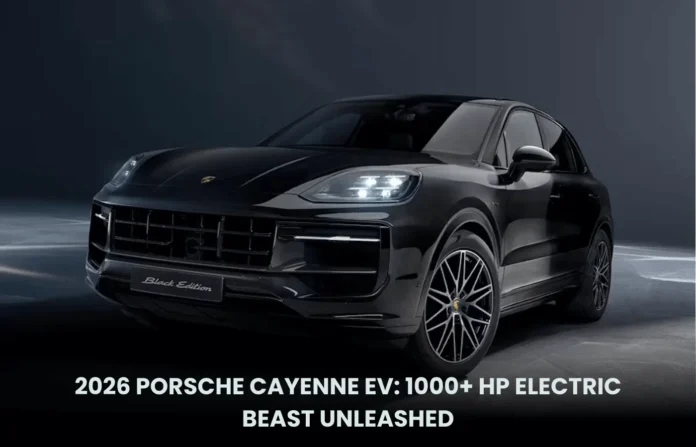
Porsche has always known how to turn heads, and the Cayenne EV takes that to new heights. Gone are the smooth, flowing lines of the current internal combustion engine (ICE) model; in their place is a more aggressive, muscular stance that screams performance. Spy shots from the Nürburgring reveal a prototype with wider arches, aero elements, and a massive fixed rear wing on what appears to be the Turbo variant. It’s like the Cayenne grew muscles overnight, ready to tackle both the track and the trail.
At the front, slim LED headlamps borrow cues from the Macan EV, featuring four horizontal daytime running lights that double as indicators. The fascia is mostly closed off for better aerodynamics, but an active lower grille—reminiscent of the latest 911—hints at smart cooling tech. Moving to the rear, a thin LED light bar stretches across the tailgate, paired with a diffuser that looks mean enough to intimidate rivals. Available in both standard SUV and Coupe body styles, the Cayenne EV will sit above the Macan EV in Porsche’s lineup, offering rear-wheel and all-wheel drive options.
This design isn’t just for show. Porsche engineers have put the prototype through virtual simulations and real-world paces, cutting development time by 20% using AI to skip an entire prototype stage. Picture this: digital twins racing on the Nürburgring before the physical car even hits the tarmac. It’s a game-changer, ensuring the final product is honed to perfection.
Porsche Cayenne EV’s Power and Performance: Over 1000 HP on Tap
Let’s talk about what really gets the heart racing—the powertrain. Porsche isn’t holding back here. The top-spec Turbo model is expected to deliver more than 1000 horsepower, making it one of the most potent SUVs on the planet. Base and mid-range variants won’t slouch either, with outputs ranging from 400 to 600 horsepower. This electric powerhouse will launch with wireless battery charging, a feature that’s as convenient as it is cutting-edge, though it might come at a premium price in markets like Germany.
Range anxiety? Porsche aims to squash that with a target of nearly 600 kilometers (about 373 miles) on a single charge, keeping it competitive in the luxury EV segment. Charging speeds are impressive too—up to 400 kW, allowing a 10% to 80% top-up in just 16 minutes. And for those who tow, the Cayenne EV boasts a capacity of up to 7,716 pounds (3.5 tons), matching its ICE siblings without compromising on electric efficiency.
I remember test-driving the current Cayenne Hybrid, where the seamless blend of gas and electric power felt revolutionary. The full EV version takes that further, promising zero-emission thrills with the soul of a sports car. Recent prototypes have even set records, like shattering the SUV speed mark at Shelsley Walsh by over four seconds. It’s proof that Porsche’s EV push, despite market headwinds, is yielding results.
Inside the Cabin: Tech Meets Tradition
Step inside, and the Cayenne EV feels like a cockpit from the future while staying true to Porsche’s heritage. The dashboard is dominated by screens: a wide infotainment display, a curved digital instrument cluster, and even a dedicated screen for the front passenger. A separate touchscreen handles HVAC controls on the center console, keeping things intuitive and driver-focused.
But it’s not all digital overload. Porsche has infused the interior with premium materials and ergonomic design, ensuring long-distance comfort. Think heated and ventilated seats, ambient lighting, and space for the whole family—with 27.6 cubic feet in the rear trunk expanding to over 30 when needed. It’s perfect for weekend getaways or daily commutes, blending luxury with usability.
Drawing from my experiences reviewing high-end EVs, the Cayenne EV’s interior strikes a balance that’s often missing in competitors. It’s tech-heavy but not overwhelming, much like how the Taycan evolved Porsche’s electric ethos.
Battery Tech and Sustainability: A Step Forward
At the heart of the Cayenne EV is its pure-EV architecture, built on a platform shared with Volkswagen Group but tailored for Porsche‘s performance demands. The battery supports inductive wireless charging, eliminating cables for a seamless experience—though early reports suggest it could cost nearly €7,000 as an option.
Sustainability is key too. Porsche’s use of AI in development not only speeds things up but reduces waste by minimizing physical prototypes. Extreme testing in varied climates ensures reliability, from -40°C in the Arctic to 50°C in the desert. This rigorous approach builds on Porsche’s legacy, much like how the original Cayenne conquered off-road challenges back in 2002.
Facing the Competition: Where Does It Stand?
In a crowded luxury EV market, the Cayenne EV goes head-to-head with heavyweights like the Tesla Model X, BMW iX, and Mercedes EQS SUV. What sets it apart? That unmistakable Porsche driving dynamics. While rivals focus on range or autonomy, the Cayenne EV emphasizes fun—to the point where it promises better off-road suitability and long-distance prowess than ever.
Take the Macan EV, its smaller sibling—it’s already a hit, but the Cayenne ups the ante with more power and space. And with Porsche observing a dip in demand for ultra-premium EVs, they’re smartly offering it alongside ICE and hybrid versions to cater to all tastes. It’s a pragmatic move in a shifting market.
For more on how it stacks up, check out Car and Driver’s in-depth preview. If you’re exploring Porsche’s lineup, our guide to the Macan EV might interest you too.
The Road Ahead: Why the Cayenne EV Matters
As we approach 2026, the Cayenne EV represents more than just another electric SUV—it’s Porsche’s statement on the future. With global EV adoption accelerating, this model could inspire a new wave of enthusiasts. Picture families ditching gas guzzlers for something that’s fast, green, and fun. Or executives zipping through city traffic with zero emissions.
But challenges remain. Porsche’s recent strategic shifts, including delays in some EV projects due to cooling demand, highlight the industry’s volatility. Yet, the Cayenne EV presses on, with innovations like AI-driven development paving the way for quicker, smarter car-making.
In my view, after years of tracking automotive trends, this could be the EV that converts skeptics. It’s not about going electric for the sake of it; it’s about enhancing the drive. If you’re in the market for a luxury SUV that packs a punch, keep an eye on this one—it might just electrify your world.
